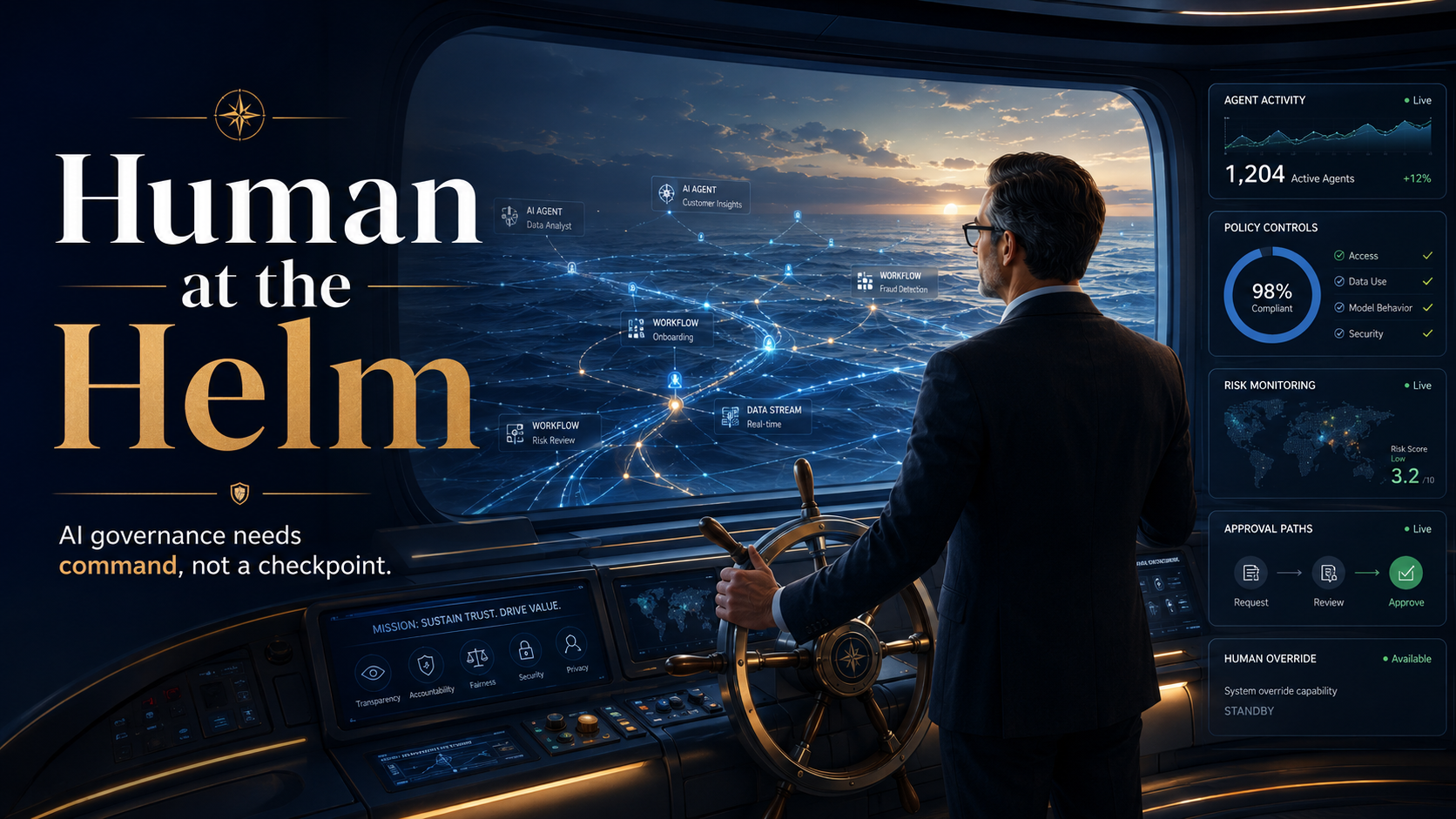
Human at the Helm: 4 Rules for Better AI Governance

Why Enterprise AI Governance Needs Command, Not a Checkpoint
Most AI governance was built for a kind of AI that is already disappearing.
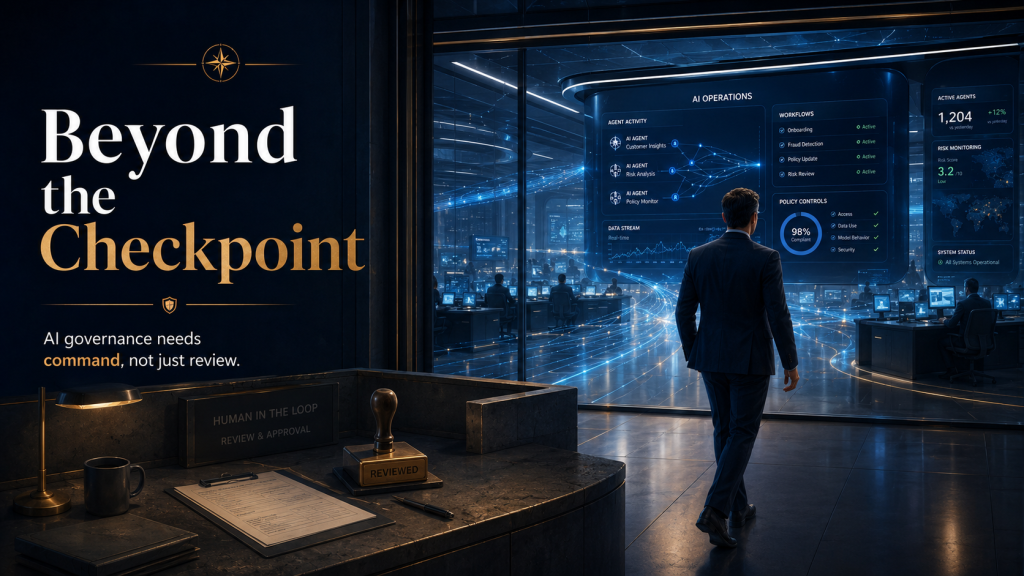
“Human in the loop” was the right idea for a world where AI made suggestions. The model proposed. A person reviewed. Nothing happened until a human said yes. The human sat at a checkpoint, the work waited in a queue, and approval was the gate. For that world, the loop was sound engineering and sound governance.
The AI enterprise landscape of 2026 is already way different than what it was in 2025.
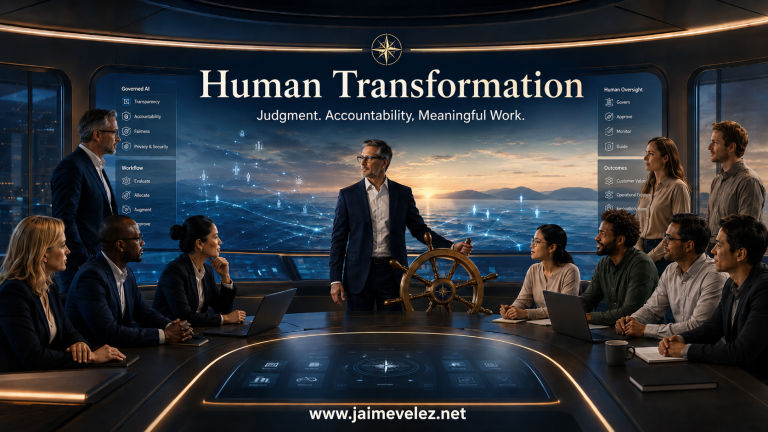
The better idea now is Human at the Helm.
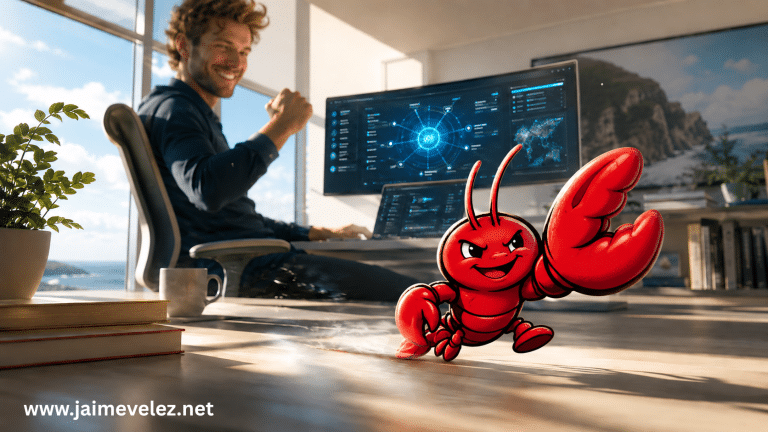
As I wrote in my previous article, the lobster is loose, my friends!
In today’s AI world, agents can open a ticket, move the file, query the record, send the message, and call the next tool in the chain without pausing for permission.
They do not wait in your inbox for a thumbs up. By the time a human gets around to reviewing, the action has already happened.
So “human in the loop” quietly changed jobs. It stopped being control and became cleanup. Much of the industry has not noticed, because the phrase still sounds responsible.
That is the real problem. This is not a vocabulary debate. It is an architecture gap wearing old vocabulary.
We do not need a human in the loop. We need a human at the helm.
First, give the loop its due
Before I retire the phrase, I want to be fair to it.
“Human in the loop” got something important right. It insisted that automation should not run unchecked, that a person should stand at the decision gate, and that someone should be able to say no. A generation of controls, model risk practices, and review boards grew out of that instinct, and they prevented real harm. If you helped build those controls, you were not wrong. You were early, and you were right for your era.
The era simply changed underneath the language. A checkpoint works when the system stops and waits for you. It does not work when the system acts and tells you later. You cannot review your way to control over something that has already moved.
So this is not an argument that the old model was foolish. It is an argument that it has run out of road, and that we owe it an honest upgrade rather than a louder version of the same idea.
What it means to have a Human at the Helm
A person in the loop is a reviewer. A person at the helm is in command.
The difference is not seniority or vocabulary. It is posture. A reviewer waits for an output and judges it. A commander sets the direction, reads the conditions, decides when to push, when to slow, and when to stop, and carries the accountability for where the vessel ends up. The technology can be astonishing. Direction still matters more than motion.
This is what it means to have real AI governance.
Security protects the system. Compliance proves obligations are being addressed. Risk management decides what uncertainty the organization is willing to carry. Governance defines who has authority, who is accountable, and how decisions get made.
At the helm, there are some things that stay human by design, not by accident.
Direction. A named person (not another agent) decides what the system is for and what good looks like.
Judgment. The hard calls, the ambiguous ones, the ones with ethical or regulatory weight, stay with a human who can be questioned.
Accountability. When the system acts, a specific person owns the outcome. Not a committee. Not an email distribution list that no one ever responds to. Not a vendor. Not the model. A name.
Authority to stop. The human keeps a real, tested ability to halt the system, and knows how to use it. A kill switch nobody can find is just decoration.
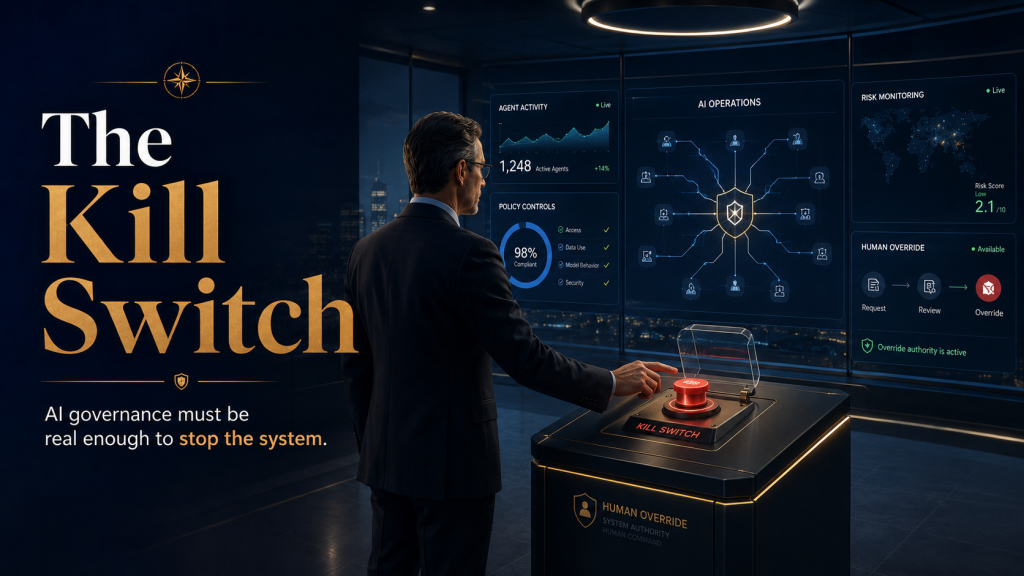
AI can assist all of this. It can draft, classify, compare, surface patterns, and recommend the next action faster than any team. What it must not do is quietly inherit the direction, the judgment, the accountability, or the authority to stop. Those do not transfer. They are the helm.
AI amplifies whatever you hand it
Here is the uncomfortable part for leaders.
AI is not neutral in practice. It amplifies the system you connect it to. Hand it clear outcomes, clean ownership, and honest accountability, and it scales clarity. Hand it political decision-making, scattered data, and processes nobody can explain, and it scales the dysfunction, faster and with a confident tone.
The risk I worry about is not the science fiction version. It is the boring version. The enterprise that uses AI to produce more dashboards, more summaries, more automated nudges, and more activity, then mistakes the volume for progress. AI is very good at making motion look like results. Governance exists to tell the difference.
That is why the helm has to come before the automation, not after. You do not bolt judgment onto a system once it is already acting. You decide, first, that a human is steering.
The standards already point this way
None of this is fringe. The major frameworks were drafted by people who saw this coming. The NIST AI Risk Management Framework, ISO/IEC 42001, and the EU AI Act all put human oversight and clear accountability near the center of responsible AI.
What they describe in the language of policy, the helm describes in the language of command.
HELM is not a replacement for NIST AI RMF, ISO/IEC 42001, or the EU AI Act. It is a practical translation layer for leaders who need to turn oversight language into operating behavior.
The gap is not in the standards. It is in how most organizations implement them, as checkpoints to pass rather than command to hold.
A framework can require human oversight. Only your operating model can make that oversight real.
H.E.L.M. as the operating model
A philosophy that cannot be operationalized is just a nice quote. So here is how a human actually holds the helm.
Four moves, in order. I call it H.E.L.M. (and yes, I came up with this. Not AI)
These four moves are the rules the title promises.
Rule #1 – H. Humanize the Outcome.
Before you deploy or govern anything, name the human and business value the system must create, and name the risk you refuse to accept. Then name the person accountable for both. Governance starts by defining what good looks like, what is unacceptable, and whose name is on the line. The question stops being “what can the model do” and becomes “what outcome are we on the hook for, and who owns it.”
Rule #2 – E. Eliminate the Noise.
Before you add oversight, cut the oversight that does not reduce real risk. This is the step most programs skip, and the one that matters most. More on it in a moment.
Rule #3 – L. Leverage AI Wisely.
Put AI and agents only where they amplify human judgment, inside scoped authority and tested guardrails. Define the lane, the limits, the escalation path, and the stop. The test is not “can we automate this decision.” It is “should this decision ever leave human hands, and where does a human stay accountable when it is assisted.”
Rule #4 – M. Measure What Matters.
Govern with risk intelligence, not activity counts. Models deployed, prompts logged, and reviews completed are motion, not assurance. Measure whether the system is producing the value you defined, staying inside the risk you set, and remaining something a human can see, explain, and stop. If your AI metrics would look identical on the day everything is fine and the day something is quietly going wrong, you are measuring the wrong things.
The letter that does the most work: Eliminate the Noise
I want to spend real time on E, because it is where most AI governance goes to perform.
Walk into a mature program and you will find oversight that exists to be seen. Reviews that rubber-stamp because saying no is career friction. Committees that meet to decide when the committee should meet again. Controls that generate a satisfying paper trail and zero assurance. Approval chains that survive because someone, once, got nervous. It looks like governance. It produces the documents of governance. It manages almost no real risk.
I have a blunt name for it. Compliance cosplay. The costume of control without the control.
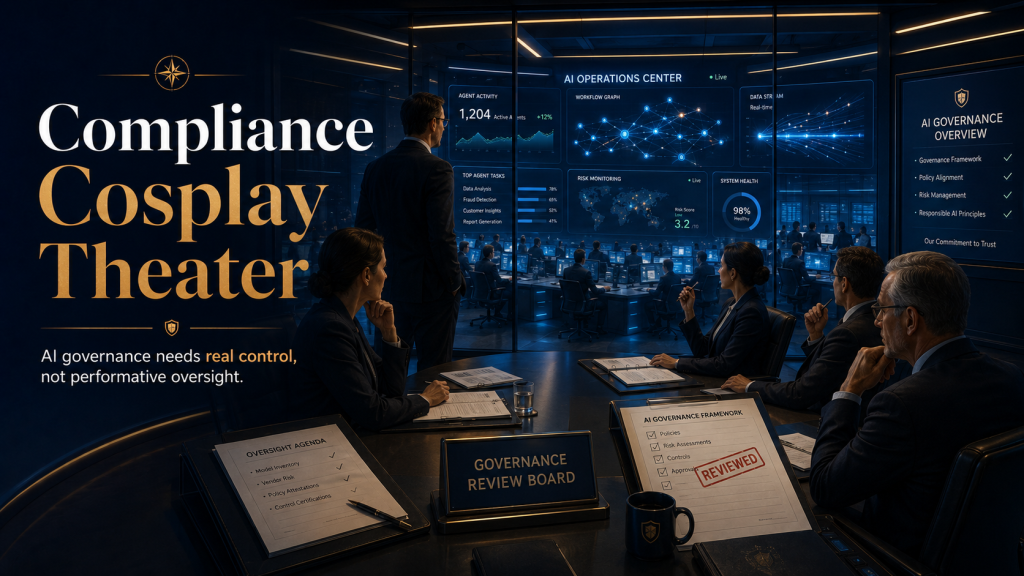
The honest move, and the uncomfortable one, is to cut it. Before you stand up a new AI review board, ask which of your existing controls would have caught the failure you are afraid of. Most programs cannot answer that. A control that produces activity but not confidence is not protecting you. It is consuming the attention and the credibility you will need when something real happens.
I have sat in many of these reviews. I lead them. It often takes only a few minutes of talking a control through for a team to see whether it creates real value or just the appearance of it, and that time is always well spent. The hardest part is not the analysis. It is building enough psychological safety in the room that people feel free to admit the uncomfortable thing: this control protects no one. Once they can say that out loud, the noise names itself.
Eliminating the noise is not deregulation. It is the opposite. It is refusing to let fake oversight crowd out the real kind. You cannot steer a ship cluttered with instruments that measure nothing.
The helm is a responsibility, not a slogan
The future of enterprise AI will not belong to the organizations that automate the most. It will belong to the ones that stay clear about what they are steering toward, honest about which controls are real, and disciplined about keeping a named human in command of systems that now act on their own.
That takes more than tools. It takes clarity about outcomes, the courage to cut the theater, and the humility to keep judgment in human hands even when the machine is faster.
Human in the loop asked a person to watch the machine.
Human at the Helm asks a person to command it.
One of those is enough for the world we are entering. The other is not.
Human at the helm is not a phrase to admire. It is a seat to take.
Take it before something else does.