Human Transformation Is the Missing Link, Not AI

I have spent more than three decades inside enterprises, from scrappy startups to Microsoft and to some of the largest financial institutions in the world. In that time I have lived through reengineering, Six Sigma, Agile at scale, digital transformation, cloud transformation, data transformation, and now the biggest one of them all: AI transformation.
Here is what watching transformations rise and fall has taught me.
The technology was never the hard part. The humans were never the problem.
The way we organize humans around the work is where every transformation goes to live or die.
And right now, across every boardroom on the planet, history is repeating itself.
Companies are pouring billions into AI. Nearly every Fortune 500 CEO has an AI mandate, an AI task force, and an AI line item that would make a defense contractor blush. Yet the value is not showing up at anywhere near the scale of the investment.
The research from every major firm tells the same uncomfortable story: almost everyone is investing, almost no one is converting.
Why?
Because the industry is attacking the AI ROI problem from two directions, and both of them stop short of the place where transformation actually happens.
The missing link is not a better model, a bigger platform, or a smarter agent.
The missing link is Human Transformation.
The Two-Front War on AI ROI
Walk into any large enterprise today and you will find the same battle plan being executed on two fronts.
From the top down, leadership is building the scaffolding. AI governance programs. Transformation offices. Reorgs that shuffle boxes on the org chart. Centers of excellence. Risk frameworks. Investment committees. Armies of consultants from IBM, EY, PwC, and McKinsey’s QuantumBlack arriving with playbooks, maturity models, and slide decks thick enough to stop a bullet.
From the bottom up, the workforce is being trained. AI mindset programs. Prompt literacy workshops. Adoption campaigns. Communities of practice. Lunch-and-learns. Champions networks. Name Your Agent contests. Enthusiastic employees experimenting with copilots and building their first automations.
Let me be clear: both fronts matter.
I work in AI Security and Governance in regulated financial services. I will be the last person to tell you that governance is optional. And I have seen firsthand how a single well-trained employee can unlock value an entire steering committee could not find even with a map and a flashlight.
But here is what the trenches have shown me, transformation after transformation.
Both approaches are necessary. Neither is sufficient.
Because between the executive strategy deck and the employee training session sits the most powerful and least managed force in the enterprise.
Culture. The messy middle.
I first felt the weight of this truth while earning my Master’s in Organizational Leadership at Judson University, where one phrase attributed to Peter Drucker was impressed on me again and again:
Culture eats strategy for breakfast.
The Messy Middle Is Where AI ROI Goes to Die
The messy middle is not a layer on the org chart. You cannot point to it in the operating model. But everyone who has ever worked inside a large organization knows exactly where it is, because they live in it every single day.
It is where incentives actually operate, regardless of what the values poster in the lobby says. It is where fear lives quietly and votes loudly. It is where middle managers either translate change into action or smother it in its crib, often without ever saying no out loud. It is where turf gets protected, where decision rights are ambiguous by design, and where fake work survives because nobody is measured on eliminating it.
It is where everyone says innovation while the actual reward system pays out for compliance theater, meeting theater, status theater, and the PowerPoint interpretive dance.
Top-down programs cannot reach the messy middle because governance can mandate behavior but it cannot manufacture belief.
Bottom-up programs cannot survive the messy middle because a newly trained, newly inspired employee returns on Monday morning to the same incentives, the same manager, the same workflows, and the same unspoken rules that punished initiative last quarter.
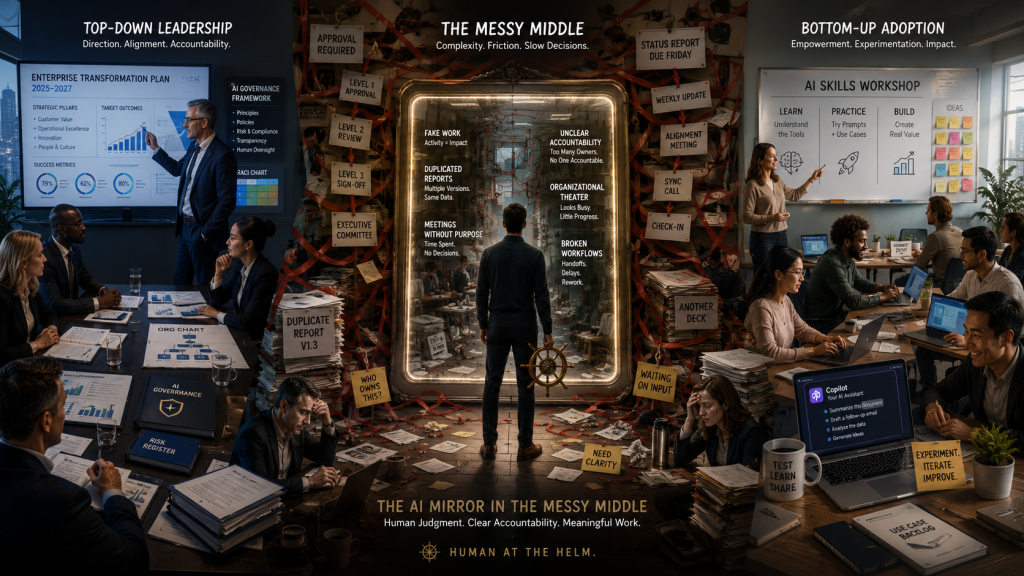
This is where AI ROI goes to die. Quietly. Without a funeral. The pilot succeeds, the deck gets presented, the applause happens, and six months later nothing about how the organization actually works has changed.
I have watched this exact movie with different technology in the starring role at least five times in my career. The only thing that changes is the logo on the software.
Years ago I sat in a transformation readout where the executive sponsor declared victory on a program that had, by every dashboard metric, succeeded. Training completion: 94 percent. Tool adoption: ahead of plan. Governance gates: all green. Then a director three levels down asked one quiet question: “So am I still measured on the old numbers this quarter?” The room went silent, because everyone already knew the answer. The incentives had not moved an inch. Within a year, neither had the organization.
That is the messy middle in a single sentence. It does not fight change. It simply outlasts it.
AI Is the Great Exposer
Here is where this transformation is genuinely different from every one that came before it, and why I believe the stakes are so much higher.
Previous technologies mostly automated tasks at the edges. AI does something far more dangerous to the status quo. AI holds up a mirror.
I wrote about this in The Death of Bullshit Jobs: AI is the Great Exposer. It is not evil. It is not here to take your job. It is here to reveal, with brutal clarity, which work was creating value and which work was theater all along.
When an AI agent can produce the status report in four seconds, the question is no longer how to write status reports faster. The question is why a highly paid professional was spending six hours a week producing a document nobody read. When AI can synthesize the analysis, route the request, and draft the response, the organization is suddenly forced to confront what its layers of coordination were actually for.
AI exposes where decisions are slow because governance is genuinely necessary, and where decisions are slow because nobody wants to own the risk. It exposes whether leaders trust their people or merely monitor them. It exposes whether managers add clarity or simply relay noise with a title attached. It exposes whether the org chart still serves the work or mostly protects itself.
This is why I argue in The Org Mesh Is Coming that the traditional org chart is legacy infrastructure. It was built for an era when information moved slowly and coordination was expensive. That era is over. The structure that replaces it, what I call the Org Mesh, is a governed network of human judgment, AI agents, decision rights, controls, and accountability that forms around real work instead of rigid hierarchy.
But here is the critical point that most leaders miss.
You cannot deploy your way into the Org Mesh. You cannot train your way into it either. The org chart is not just a diagram. It is a fossilized record of decades of human choices about power, trust, status, and control. Changing the diagram without changing the humans is like redecorating the Titanic.
That change has a name. It is Human Transformation, and it is the discipline almost nobody is practicing.
The Missing Link, Defined
So what exactly do I mean by Human Transformation?
I do not mean another training program. I do not mean a culture initiative with a catchy internal brand and a mandatory kickoff webinar. And I emphatically do not mean building an “AI culture,” a phrase I would like to see retired before it does any more damage.
AI is a capability. A powerful one. But capabilities do not deserve cultures built around them.
Nobody demanded an “electricity culture” in 1910 or a “spreadsheet culture” in 1985.
Centering the culture on the tool guarantees you will optimize for adoption metrics instead of outcomes, and you will be rebranding the whole program the moment the next technology wave arrives.
Human Transformation is something deeper and older. It is the deliberate rethinking, reshaping, and redesigning of how humans work, decide, coordinate, and create value, done with the honesty that AI has now made unavoidable.
Five Hard Things
In practice, Human Transformation means five hard things.
- It means redesigning work around outcomes and judgment instead of activity and presence, so the theater AI exposes actually gets eliminated instead of automated.
- It means making decision rights explicit, so accountability survives automation instead of dissolving into “the system decided.”
- It means rebuilding incentives so the messy middle rewards the behavior the strategy deck describes, instead of quietly punishing it.
- It means investing in the capabilities that remain irreducibly human: judgment, context, ethics, relationships, creativity, and the courage to own a consequence.
- And it means leaders going first. Not sponsoring the change. Living it. Publicly changing how they decide, what they measure, and what they tolerate.
Notice that AI barely appears in that list. That is the point.
Human Transformation is not a workstream inside your AI program.
Your AI program is a workstream inside Human Transformation.
Get that hierarchy backwards, and you will spend three years and nine figures learning what the maturity studies already tell us: the technology arrived and the organization did not.
Why I Believe This Is the Deeper Idea
I did not arrive at Human Transformation through AI. I arrived at it years before, through a simpler question that I explored in What Does It Even Mean to Make Work Human?: why does so much of modern work grind down the very people it depends on?
Make Work Human was always the why.
Work should preserve dignity, meaning, health, judgment, creativity, and responsibility. Systems, schedules, and careers should be designed to honor the humans inside them, not merely extract from them. As I wrote in Magnifica Humanitas and AI, the goal has never been to remove humans from work. The goal is to remove the dehumanizing parts of work from humans.
For years, that felt like a moral argument. A conviction. Something you believed because of who you wanted to be as a leader. The kind of idea that earned polite nods in the leadership offsite and then lost every resource battle to the initiative with the hard ROI slide.
AI just turned it into a business imperative. The soft stuff is now the hard stuff. The people-first argument and the value-creation argument have collapsed into the same argument, and the CEOs who see that first will enjoy a compounding advantage over the ones still waiting for the technology to save them.
Because the organizations that treated their people as interchangeable task-executors are now discovering that tasks are exactly what AI absorbs first.
What remains, what actually differentiates one enterprise from another in the AI age, is everything Make Work Human was pointing at all along: human judgment, human trust, human accountability, and humans who bring their full capability to work because the work deserves it.
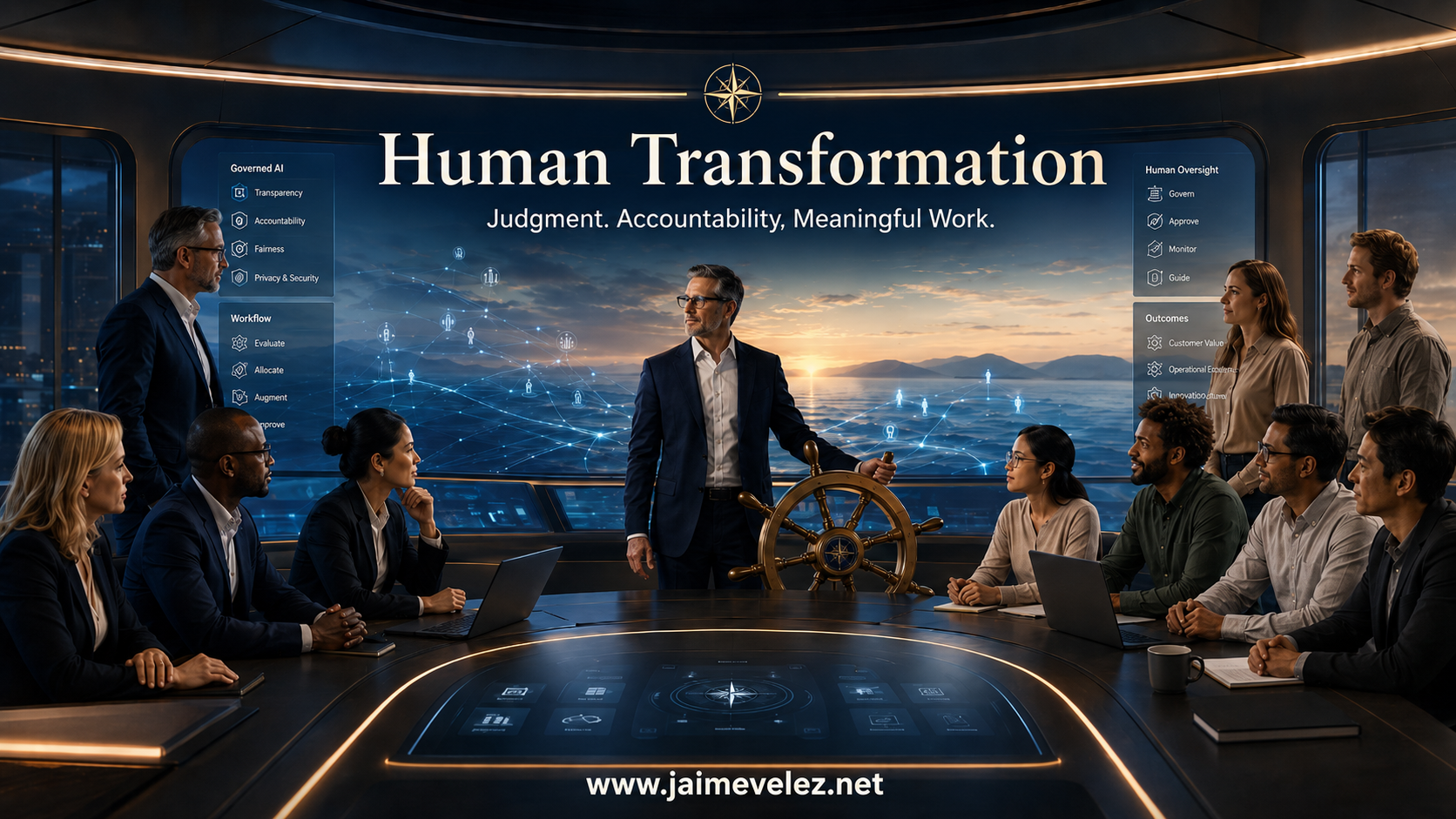
Human at the Helm is the how.
AI may assist, recommend, generate, automate, and coordinate. But humans must remain responsible for direction, context, accountability, consequence, and meaning. Not as a compliance checkbox. As the organizing principle of how the enterprise runs.
The Org Mesh is the operating model where all of it lands: a structure where governed AI capability and human judgment are woven together deliberately, with controls and evidence, instead of bolted together accidentally and audited after the incident.
The why, the how, and the operating model.
That is the architecture of Human Transformation. And every piece of it puts humanity first and technology second, not because it is sentimental, but because it is the only sequence that has ever actually worked.
Start in the Middle
If you lead a large organization, here is the uncomfortable question this thesis puts on your desk.
Your top-down programs are funded. Your bottom-up training is underway.
Now look honestly at the middle of your organization and ask: if AI exposed every piece of theater, every ambiguous decision right, every incentive that contradicts the strategy, and every layer that relays instead of adds, would your culture metabolize that truth, or bury it?
Because AI will expose it. That part is no longer optional.
The only decision left is whether the exposure leads to redesign or to a very expensive cover-up.
Here is where I would start, and none of it requires a new platform.
Pick one high-value workflow and map where decisions actually get made in it, not where the org chart says they get made. The gap between those two maps is your real transformation backlog.
Then audit your incentives against your AI strategy line by line, and fix the first contradiction you find, publicly, so the messy middle sees that this time the rules actually changed.
Ask your managers to name the work on their teams that exists mainly to feed reporting theater, and grant them amnesty for the answer.
And before you fund the next pilot, ask a harder question than “can AI do this?” Ask “should this work exist at all?”
You will be surprised how often the honest answer eliminates the project and frees the capacity.
None of that is glamorous. All of it is human. That is exactly why it works, and exactly why most organizations skip it in favor of another procurement cycle.
The leaders who win this era will not be the ones who bought the most tools, ran the most pilots, or trained the most prompt engineers.
They will be the ones with the courage to do Human Transformation for real: to redesign work around human judgment, clear outcomes, explicit accountability, and governed AI capability, and to build organizations where people can do meaningful work without being crushed by the machine they were told would save them.
Thirty years of transformations have taught me that the pattern only breaks when leaders change the humans’ reality, not the technology’s logo.
AI will not fix broken work. It will reveal it.
Human Transformation is what you do about what it reveals.
That is the missing link. It always was.