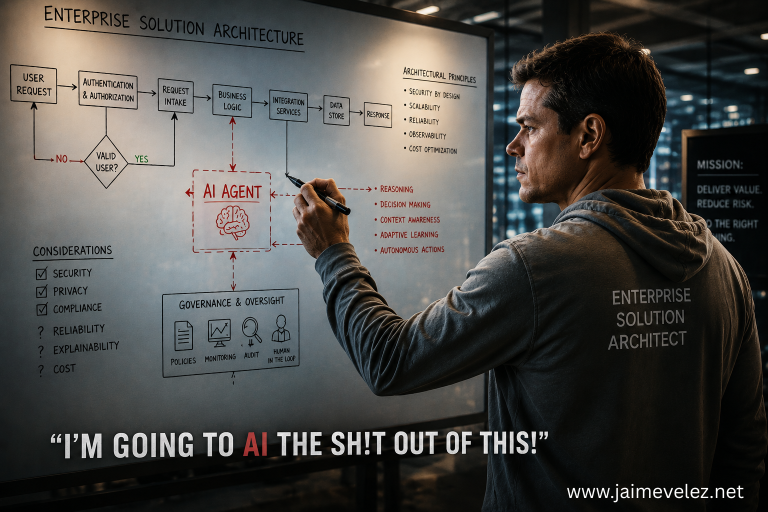
The AI Agent Boss

Why Every Career Is Becoming a Supervisory Role
The most valuable work in the modern economy is quietly shifting.
Not from humans to machines.
Not from expertise to automation.
But from manual execution to supervision and direction.
If you are paying attention, you can feel it happening inside your own job.
The spreadsheets still exist.
The code still gets written.
The documents still get drafted.
The reports still get generated.
But fewer humans are performing every step.
More humans are defining the target, reviewing the output, and deciding what ships.
That shift has a name.
Agent Boss.
And it is no longer a niche role for AI enthusiasts.
It is becoming the baseline capability for modern professionals.

The Shift From Doing to Directing
For decades, career progression meant moving from execution to management.
First you did the work.
Then you supervised others doing the work.
Now there is a third layer emerging.
You are not only supervising people.
You are supervising agents.
Software that plans tasks.
Software that drafts, analyzes, summarizes, compares, and even executes actions inside real tools.
Microsoft recently framed this shift clearly:
“The next era of work will require every employee to become an agent boss.”
That line is not hype. It is a description of trajectory.
In this new world of Human-AI Teamwork, the modern Agent Boss is someone who sets direction, defines quality, and supervises execution across both human and digital workers.
And that skill is becoming universal.
Titles Are Staying. Value Creation Is Moving.
Your title might still say:
Finance Manager, Product Owner, Security Architect, or Marketing Director.
But what actually creates value is changing.
Finance leaders still need to understand how a P&L behaves inside a spreadsheet.
Product leaders still need to define specs and trade-offs.
Security leaders still need to understand architecture risk.
Domain expertise still matters.
What changes is how that expertise flows.
It no longer flows through manual production.
It flows through agents.
You define the objective.
You define what “good” looks like.
You review what comes back.
You decide whether to trust it.
That is the operating model of the Agent Boss.
From My Substack: The First Signal
When I first wrote “Becoming an Agent Boss” on Substack, I described this role as a leadership upgrade.
I wrote:
“The future leader is not the one who knows the most. It is the one who can orchestrate humans and AI toward a shared outcome.”
At the time, that sounded aspirational.
Now it sounds inevitable.
This is no longer just executive-level thinking. It is becoming the daily experience of knowledge workers everywhere.
Execution is accelerating.
Capacity is expanding.
The bottleneck is shifting upward.
And that bottleneck is judgment.
My Own Experiment in Cybersecurity
This is not theoretical for me.
In my role as a Cybersecurity Program Manager, I currently operate with three AI agents that save me hours every week.
One helps synthesize security review data and produce structured summaries.
One assists with drafting documentation and executive-ready reports.
One supports process mapping and workflow improvement across our governance functions.
Before, I executed most of this work manually.
Now I define outcomes, review & revise outputs, refine prompts, and elevate the result.
The time I recover does not disappear.
It gets reinvested.
Into strategic thinking.
Into helping my team adopt AI responsibly.
Into refining governance models for AI usage inside our function.
Into making work human.
That is the leverage of the Agent Boss.
The work becomes less about typing and more about thinking.
Less about producing and more about directing.
Why Supervision Is the New Scarce Skill
When execution accelerates, supervision becomes the constraint.
The most valuable input in the modern workplace is no longer effort.
It is Clarity.
Clarity of outcome.
Clarity of acceptance criteria.
Clarity of customer impact.
Clarity of risk tolerance.
Agents can execute against whatever standard you give them.
If the standard is vague, the output will be vague.
If the objective is weak, the result will be weak.
Garbage in. Garbage out still applies.

The Agent Boss understands this deeply.
They invest more time defining “good” than performing each step.
They understand that speed without standards is chaos.
They embrace direction as their core responsibility.
The Organizational Constraint
Here is the uncomfortable part.
The limiting factor is not model capability.
It is organizational inertia.
Technology is improving on a monthly cadence. Heck… I’d argue weekly.
Many organizations still plan on annual rhythms.
When improvement cycles compress, slow adaptation becomes expensive.
Teams that cannot absorb change quickly lose time.
And time becomes the scarce resource.
Competitive advantage starts to look like adoption speed.
The Agent Boss is not only a personal skill. It is a cultural advantage.
Organizations that develop people who can supervise agents well will compound productivity.
Those that hesitate will struggle under their own legacy workflows.
When Agents Act, Supervision Endures
Modern AI is moving beyond text drafts.
With techniques like reasoning loops and tool integration, agents can now:
Think.
Act inside software.
Check results.
Iterate.
Work that once required constant manual oversight can now be executed with verification built in.
That does not eliminate humans.
It elevates them.
When agents can act and check, the durable human role becomes:
Direction.
Oversight.
Trust calibration.
Final decision authority.
The Agent Boss does not compete with agents.
They command them.
The Leadership Opportunity
This is not a threat narrative.
It is a leadership opportunity.
For the first time in decades, the baseline skill of work is shifting.
You do not need to become a machine learning engineer.
You do need to become excellent at:
Defining outcomes.
Communicating expectations.
Judging quality.
Mapping processes.
Optimizing workflows.
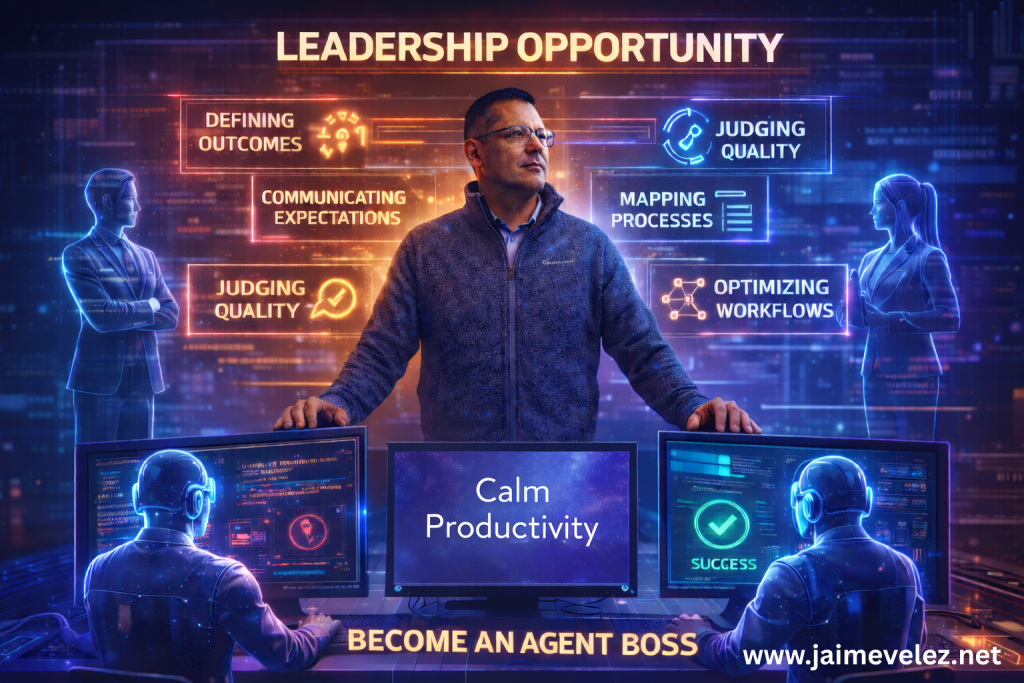
The value shift from manual execution to supervision and direction is happening across industries.
And it is democratizing leadership.
You no longer need direct reports to act like a leader. The truth is you never did.
If you manage agents effectively, you are already practicing leadership.
Every professional has the opportunity to become an Agent Boss.
It Won’t Be Long
It will not be long before most professionals manage a small army of agents.
Some will resist.
Some will ignore.
Some will delegate poorly and blame the tools.
But those who embrace this shift will experience something powerful:
More leverage.
More strategic influence.
More time focused on decisions that shape outcomes.
The future of work is not humans versus AI.
It is humans supervising AI.
The question is not whether agents will become part of your workflow.
The question is whether you will direct them well.
A Call to Action
Start small.
Identify one repetitive task you perform weekly.
Document the outcome you actually care about.
Define what “good” looks like.
Then experiment with an agent executing that task under your supervision.
Do not aim for perfection.
Aim for clarity.
Understand new concepts, like the Human-Agent Ratio.
Develop an AI Mindset.
The sooner you practice being an Agent Boss, the more natural it will feel as the workplace evolves.
Because make no mistake.
This is not a trend.
It is a convergence.
Most knowledge work careers are becoming supervisory roles.
And this is one of the greatest leadership expansions available to modern professionals.
Change is coming. It’s already knocking at your door.
Bullshit jobs are already disappearing.
The future does not belong to those who do the most.
It belongs to those who direct the most effectively.
Welcome to the era of the Agent Boss.