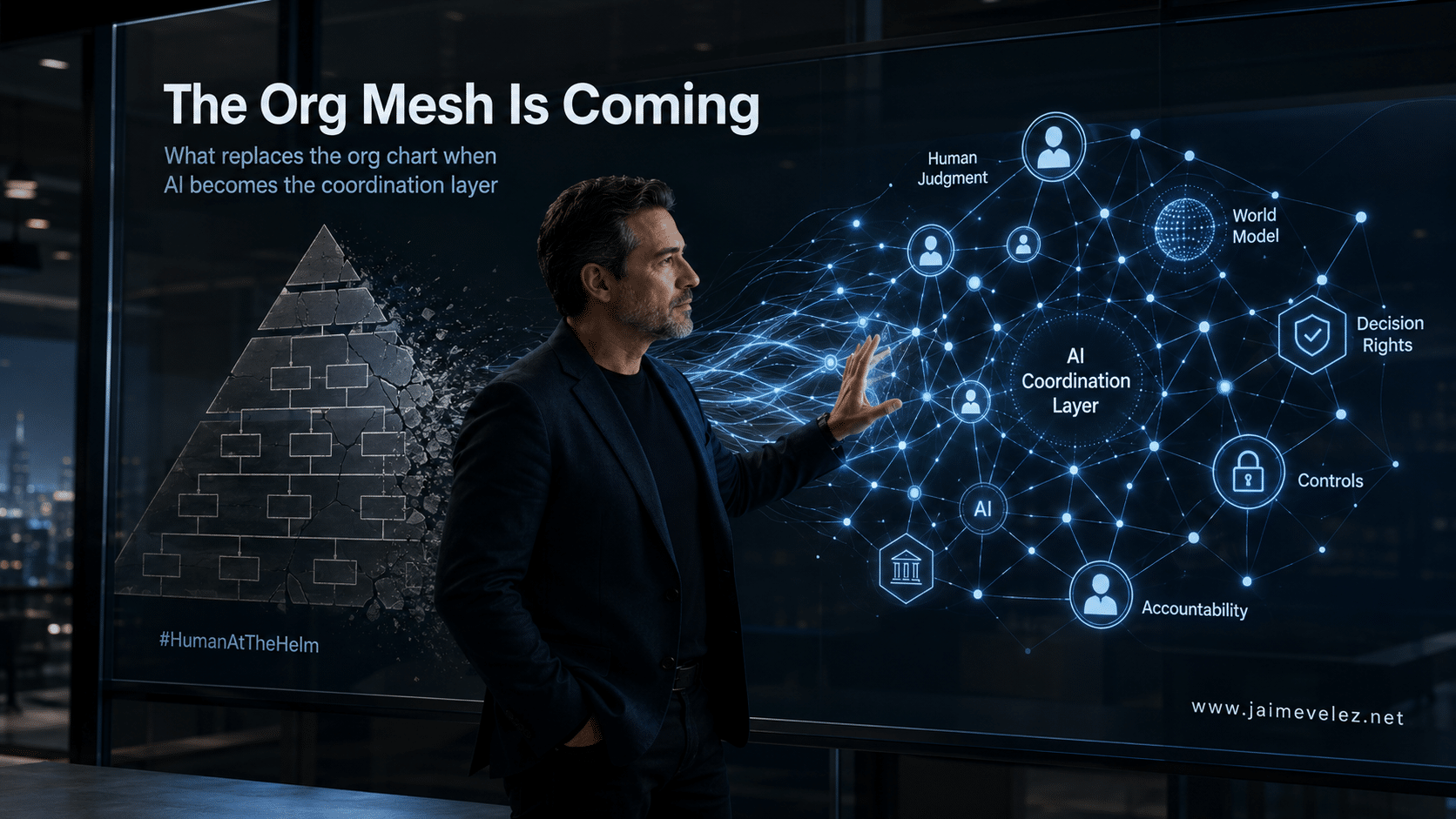
The Org Mesh Is Coming

What replaces the org chart when AI becomes the coordination layer
The org chart solved a problem that no longer exists.
The Org Mesh is what replaces it, if you build it with judgment instead of hype.
Jack Dorsey is running the experiment live.
On March 31, 2026, Dorsey co-authored an essay with Sequoia’s Roelof Botha called “From Hierarchy to Intelligence.” The argument was not simply that AI will make workers more productive. That is the shallow version. The deeper argument was that AI can change how companies organize themselves.
Their phrase was direct: “a company built as an intelligence.”
That sentence matters.
Because if a company can be built as an intelligence, then the org chart is no longer the operating system. It becomes legacy infrastructure. A static map of authority in a world where information, work, context, and decisions can move dynamically.
A few days later, on Sequoia Capital’s Long Strange Trip podcast, Dorsey described the logical endpoint of the idea: in the ideal case, there would be no layers at all, with every Block employee effectively reporting directly to him through the intelligence layer.
Then in May, at the JPMorgan technology conference, he put a deadline on it.
Block currently runs about five organizational layers deep beneath him. He wants that down to two or three by the end of this year. Every manager at Block is now required to be technical and ship code. And he is claiming early proof: production code changes per engineer were up more than 2.5x between January and mid-April.
This is not a thought experiment anymore.
It is a public company restructuring itself in front of analysts, with metrics and a deadline.
And if you work inside a large enterprise, you should be paying very close attention. Because some version of this experiment is coming to your org chart.
Probably sooner than you think.
The Week the Argument Ended
I drafted the first version of this essay on April 4th, the week Dorsey’s essay went viral. But I never published it. Until now.
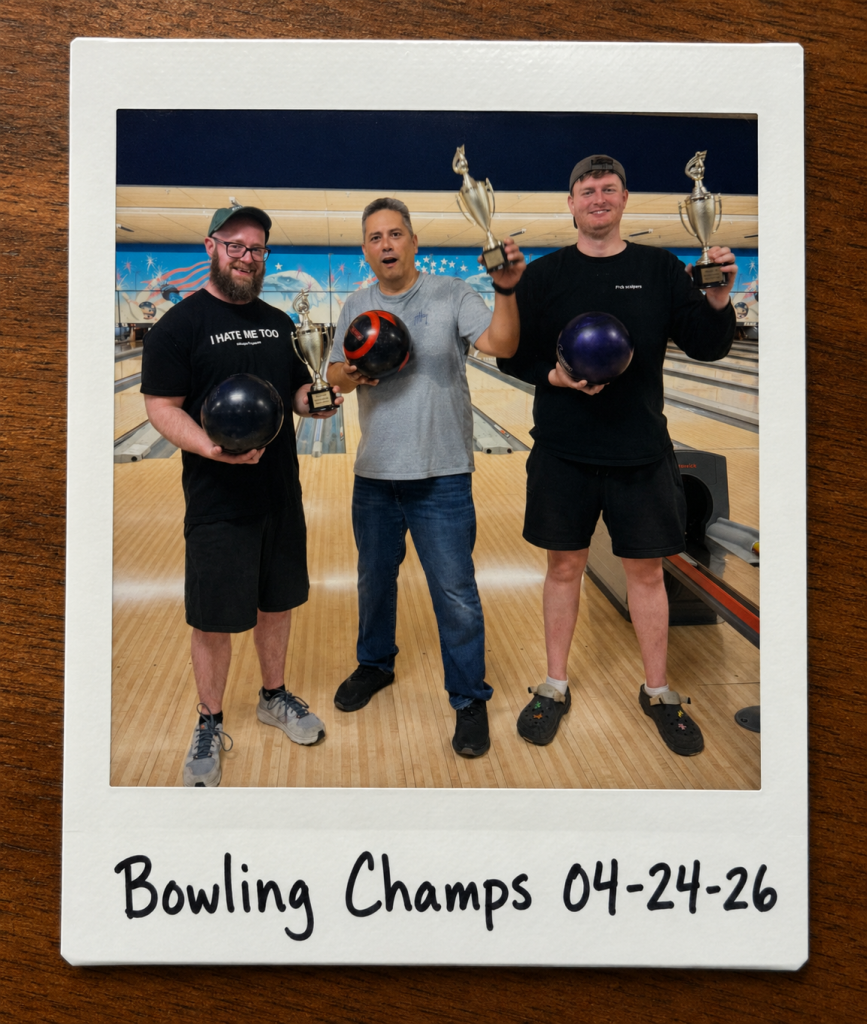
I got distracted with an extremely busy work schedule, life, and winning my local bowling alley’s Friday night trio championship.
That’s right. When I am not building with AI or writing about it, you will find me Friday nights throwing a 14-pound ball down at Parkside Lanes.
In the weeks since, the rest of corporate America caught up to the premise.
The press has started calling it “the Great Flattening,” with Business Insider reporting that the trend has moved beyond Big Tech into retail and other sectors.
Gartner projects that 20% of organizations will use AI to flatten their structures through 2026, eliminating more than half of current middle management positions. Korn Ferry found that roughly 41% of employees say their company trimmed management layers in the past year. Meta, Citigroup, CrowdStrike, and GitLab have all fueled the debate with restructurings of their own.
So the question is no longer whether AI flattens the org chart.
That argument is over.
The question now is what replaces it.
And who is accountable when it does.
A View From Inside the Machine
I have spent more than 25 years inside corporate America.
Small teams. Giant institutions. Startups with ten people and banks with twenty thousand.
Today I run cybersecurity programs inside a regulated financial institution. Which means I spend my days exactly where Dorsey’s vision collides with reality: governance, accountability, and the controls that keep a regulator from showing up at your door.
From that seat, I can tell you two things.
First, Dorsey is right about the diagnosis.
The org chart is a legacy system.
Second, almost everyone copying him is about to learn the hard way that you cannot delete a hierarchy without designing what absorbs its functions.
I call that design the Org Mesh.
Yes, I’m coining and claiming this term.
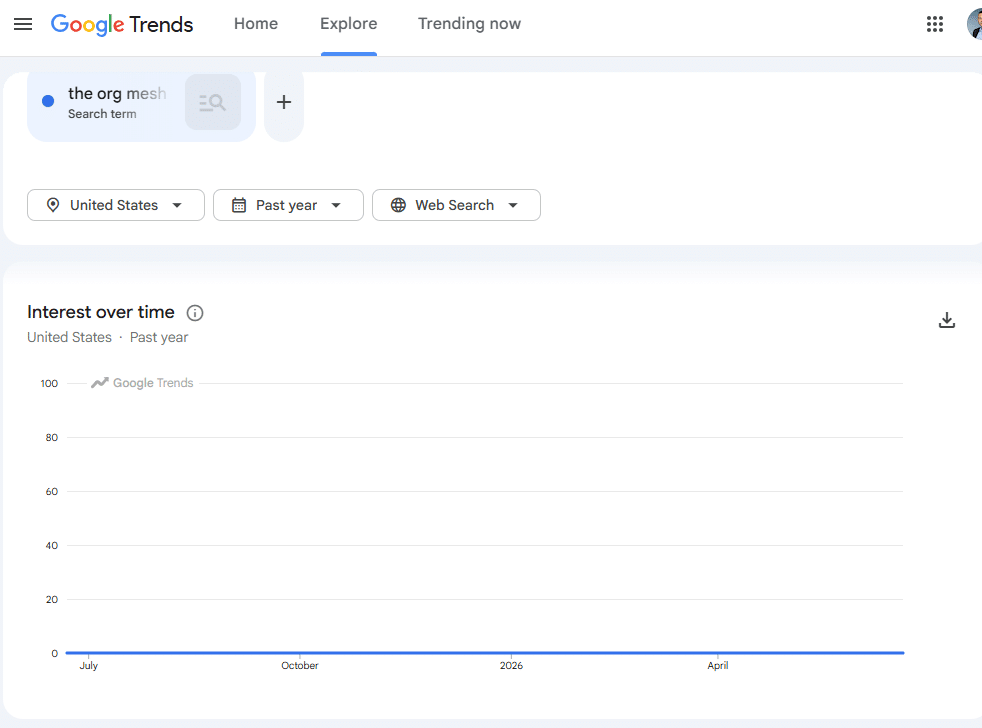
As of June 26th, 2026 this term doesn’t even appear in a 12-month search of Google Trends: (crickets)
Before we get there, you need to understand why the org chart pyramid existed in the first place.
Because the answer explains exactly why it is collapsing now.
The Org Chart Was a Communication Technology
Nobody talks about this part.
The corporate hierarchy was not invented only to concentrate power. It was invented to solve a very specific, very practical problem:
How do you move information and decisions across a large organization when you have no technology to do it for you?
Before email. Before Slack. Before Teams. Before dashboards. Before real-time collaboration.
If you ran a company with thousands of employees across multiple locations, you had a genuine coordination problem. So you built layers. Managers reported to directors who reported to VPs who reported to executives. Each layer existed to compress, translate, and pass along information.
Alfred Chandler, the historian who studied the rise of the modern corporation, called it the managerial revolution.
The hierarchy was infrastructure.
The same way roads were infrastructure for moving goods, the org chart was infrastructure for moving decisions.
Then the problem got solved.
Repeatedly. Cheaply. Completely.
The internet arrived. Then email. Then mobile. Then collaboration platforms that let a team in Chicago work in real time with a team in Manila.
The original bottleneck disappeared.
And yet the hierarchy stayed.
Why?
The Pyramid Grew an Immune System
In 2018, anthropologist David Graeber gave the answer a vocabulary in his book Bullshit Jobs: the flunkies, the box tickers, the taskmasters, the duct tapers.
Roles that exist to sustain the structure rather than serve the work.
His insight was that these roles did not multiply because leaders were lazy. They multiplied because a hierarchy that no longer serves its original purpose does not quietly retire. It reinvents its own justification. It generates work whose real product is the survival of the structure itself.
In 2018, that was theory.
In 2026, it is a quarterly earnings narrative.
Because here is the thing about AI that most coverage gets wrong.
AI is not primarily a tool for doing existing work faster.
It is a tool for revealing which work was real in the first place.
Status reports generated in seconds. Recurring problems fixed at the source. Workflows visible in real time without anyone compiling a deck about them. Dependencies surfaced automatically. Decisions routed to the right people before the weekly alignment meeting even appears on the calendar.
Graeber identified the categories.
AI is finishing the argument.
What Block Is Really Saying
The most important sentence in Dorsey and Botha’s essay is not about headcount.
It is this: Block is trying to become “a company built as an intelligence.”
That is a very different idea from giving every employee an AI assistant.
Most companies are still treating AI as an accessory. A productivity layer. A faster way to summarize meetings, draft emails, analyze spreadsheets, write code, or generate status reports.
Useful? Absolutely.
Transformational? Not by itself.
Block is making a bigger claim.
The claim is that AI can replace the coordination function hierarchy was created to perform.
In the old model, intelligence is distributed across people, and the hierarchy routes that intelligence through reporting lines. Context moves up. Decisions move down. Managers translate, summarize, prioritize, escalate, and align.
In the new model, intelligence lives partly in the system itself.
The company understands what is happening across the business because work leaves artifacts. Decisions, discussions, code, plans, blockers, customer signals, performance metrics, and operational risks become machine-readable context. AI can maintain that context continuously.
Block describes this as a company “world model.”
In AI, world models are internal representations that help agents understand an environment, predict how it changes, and plan actions.
A newer business-world-model framing applies that same idea to organizations: modeling business states, constraints, objectives, and possible actions so intelligent systems can support planning and decision-making.
And this is where the idea becomes much more important than flattening.
A flatter org chart without a world model is not transformation.
It is just a smaller pyramid with more confusion.
The World Model Is the Missing Architecture
If the Org Mesh is going to work, it needs a shared operating picture.
That is the world model.
A company world model is the continuously updated understanding of what the organization is doing, what is blocked, where resources are going, what decisions are pending, what risks are emerging, and what outcomes matter.
In a traditional company, a manager carries that context.
In an Org Mesh, the system carries much of it.
That does not mean the system replaces judgment. It means the system replaces the expensive, slow, and often distorted movement of context through layers.
This matters because a mesh without shared context becomes chaos.
Teams form, but nobody knows why. AI agents act, but nobody knows on whose authority. Work accelerates, but controls lag behind. Decisions happen in Microsoft Teams, documents, ticketing systems, dashboards, meetings, and AI tools, but the organization has no coherent view of what is actually true.
That is not an Org Mesh.
That is an org fog.
And nobody needs more fog. We have enough enterprise fog already. The fog usually has its own PowerBI dashboard too.
A real Org Mesh needs a world model that can answer basic operating questions:
What are we trying to accomplish?
Who owns the outcome?
What capabilities are available?
What decisions have already been made?
What risks are attached to this work?
What controls apply?
What is blocked?
Where is human judgment required?
Who is accountable?
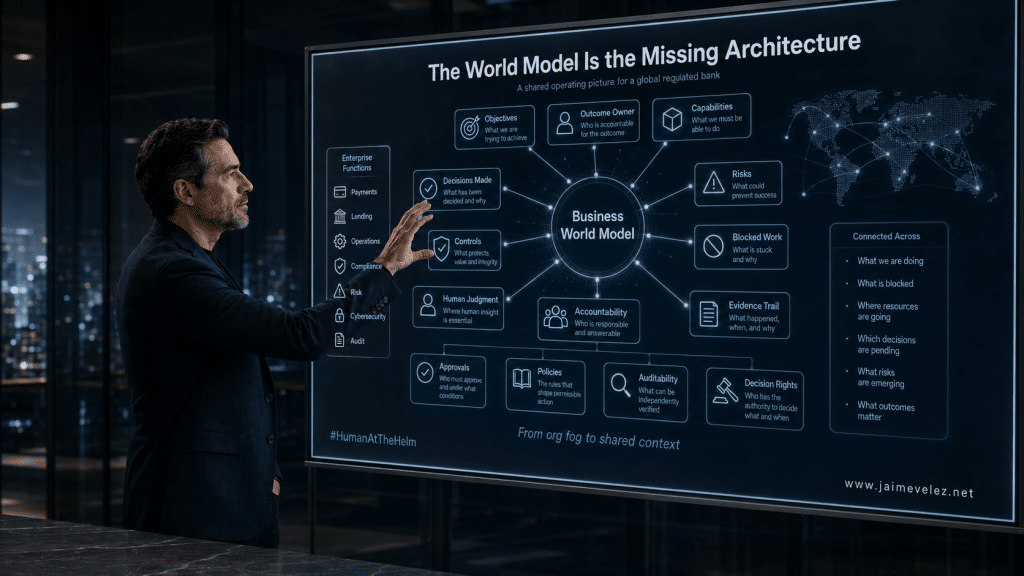
The world model is what lets the mesh move fast without losing its mind.
It is also where regulated enterprises have to be more careful than Block.
Because inside a bank, hospital, insurer, utility, or public company, the world model cannot only describe work. It has to preserve evidence. It has to support auditability. It has to make decision rights explicit. It has to show who approved what, when, under what policy, and with what information.
In other words, the world model is not just an AI strategy.
It is control architecture.
What Is the Org Mesh?
So what replaces the pyramid?
Not a flatter org chart.
Not a matrix structure with a new name.
Not another reorg that reshuffles the same boxes on the same slide.
And, this is the part the headlines miss, not Dorsey’s 6,000 direct reports either.
A single node with 6,000 connections is not a flat organization.
It is a bottleneck with a personality.
What I am describing is structurally different.
The org chart is a rigid hierarchy with a shape. A pyramid. And that shape determines everything: who has power, who gets heard, how fast decisions move, and how much energy gets consumed defending the structure itself.
The Org Mesh has no pyramid.
It is a dynamic network of human capabilities, AI agents, governed systems, and collaborative nodes that form and reform around the actual work.
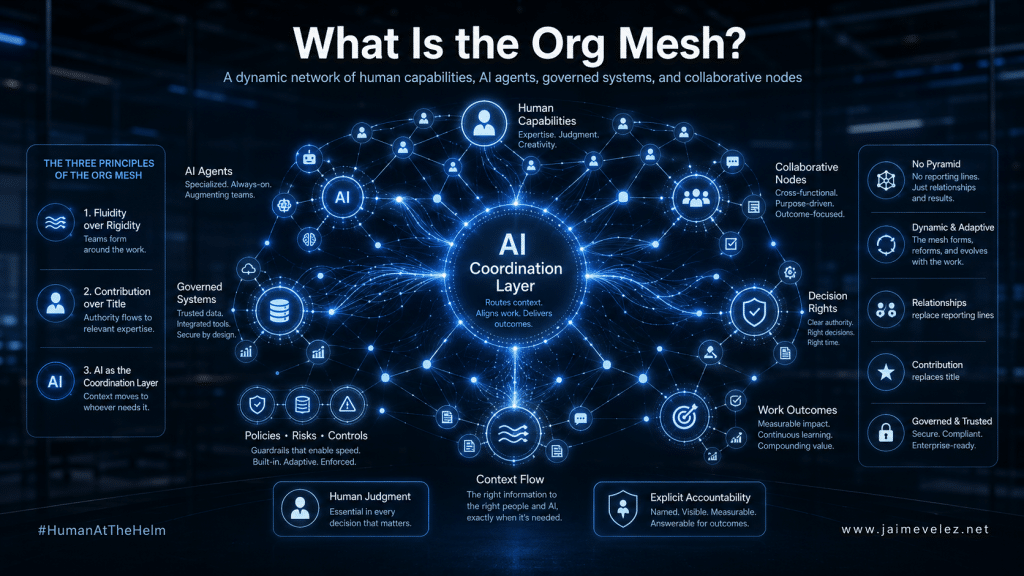
Instead of reporting lines, it has relationships.
Instead of titles that define authority, it has contributions that earn trust.
Instead of layers that compress and translate information, it has AI moving context to whoever needs it.
Instead of relying on hierarchy to imply accountability, it makes accountability explicit.
That last part matters.
Because without explicit accountability, the mesh becomes a beautiful disaster.
Fast, modern, impressive, and completely unready for the first serious incident review.
Org Mesh, Work Chart, Agentic Mesh
If you have been reading the same coverage I have, two other terms are already circling this space. It is worth saying plainly how the Org Mesh differs, because the difference is the whole point.
The first is the work chart. Microsoft, McKinsey, and Deloitte have all started using it to describe what comes after the org chart: a map of tasks, processes, and outcomes instead of reporting lines. That is a real improvement. But a work chart mostly answers one question — how does the work flow? It re-maps the work. It does not, on its own, answer who is accountable when that work goes wrong, who holds the decision rights, or whether the controls survive contact with a regulator.
The work chart is a better map.
The Org Mesh is a map with a helm.
The second is the Agentic Mesh. This one matters because it shares half my word, and the two get confused constantly. But they live on different layers.
The Agentic Mesh is technical architecture: the registries, protocols, capability cards, and observability that let AI agents discover and coordinate with each other. It is plumbing. Important plumbing — but plumbing.
The Org Mesh is not the plumbing. It is the operating model that sits on top of it and decides what the plumbing is allowed to do. Where humans hold authority. Where agents must stop and ask. Who signs their name to the outcome.
Put simply:
The Agentic Mesh is how the machines talk to each other.
The work chart is how the work flows.
The Org Mesh is how a human stays accountable for both.
You need all three. But only one of them keeps you out of the headlines for the wrong reasons.
The Three Principles of the Mesh
1. Fluidity over rigidity
Teams form around problems and dissolve when the work is done.
This is not entirely new. Microsoft, Gartner, and others have used the phrase “fusion teams” to describe multidisciplinary groups that combine business and technology expertise around a shared outcome.
But the Org Mesh goes further: it does not just fuse people across functions. It adds AI agents, shared context, explicit decision rights, and governance controls into the operating model.
The structure serves the work, not the other way around.
In the old model, work bends around the org chart. In the mesh, the organization bends around the work.
That sounds simple until you realize how much enterprise behavior exists only to protect the existing shape.
Budget cycles. Approval chains. Steering committees. Resource allocation rituals. Status decks. Governance forums that review decisions long after the real decision was made somewhere else.
The mesh does not eliminate structure.
It makes structure adaptive.
2. Contribution over title
Authority flows to the person with the most relevant insight, experience, or skill for the challenge at hand.
Not to the highest box on the chart.
Leadership becomes a function, not a position.
You lead when you are the right person to lead a particular challenge. You follow when someone else is.
That is not chaos.
That is maturity.
But it only works when contribution is visible, trust is earned, and decision rights are clear.
Otherwise, contribution over title quickly becomes influence over accountability. And every enterprise already has enough unofficial power networks hiding under official org charts.
The Org Mesh should not make those networks more invisible.
It should make them more honest.
3. AI as the coordination layer
Every bottleneck the org chart was built to manage gets absorbed, at least partially, by AI: information flow, decision routing, status visibility, dependency mapping, cross-functional alignment, and operational sensing.
That is the real shift.
Not AI as a chatbot.
Not AI as a deck generator.
Not AI as the intern who never sleeps and occasionally hallucinates with confidence.
AI as the coordination layer.
The layer that knows what work exists, where it sits, who is involved, what is blocked, what risks are attached, what policies apply, and when human judgment must enter the loop.
What remains is human.
Judgment. Trust. Creativity. Context. Wisdom. Accountability.
Which brings us to the question that should have been asked at the JPMorgan conference.
In a Mesh, Who Is Accountable?
Dorsey can compress Block to two layers because he is a founder-CEO of a technology company. He answers to a board, investors, customers, and the market.
Now try running his experiment inside a global bank.
A regulated financial institution does not just have layers.
It has controls embedded in those layers.
Segregation of duties. Maker-checker approval chains. Three lines of defense. Audit trails that must show not just what decision was made, but who had the authority to make it.
When the regulator calls, “the network decided” is not an answer.
A name is an answer.
That is where the Org Mesh becomes more than an operating model.
It becomes a governance design problem.
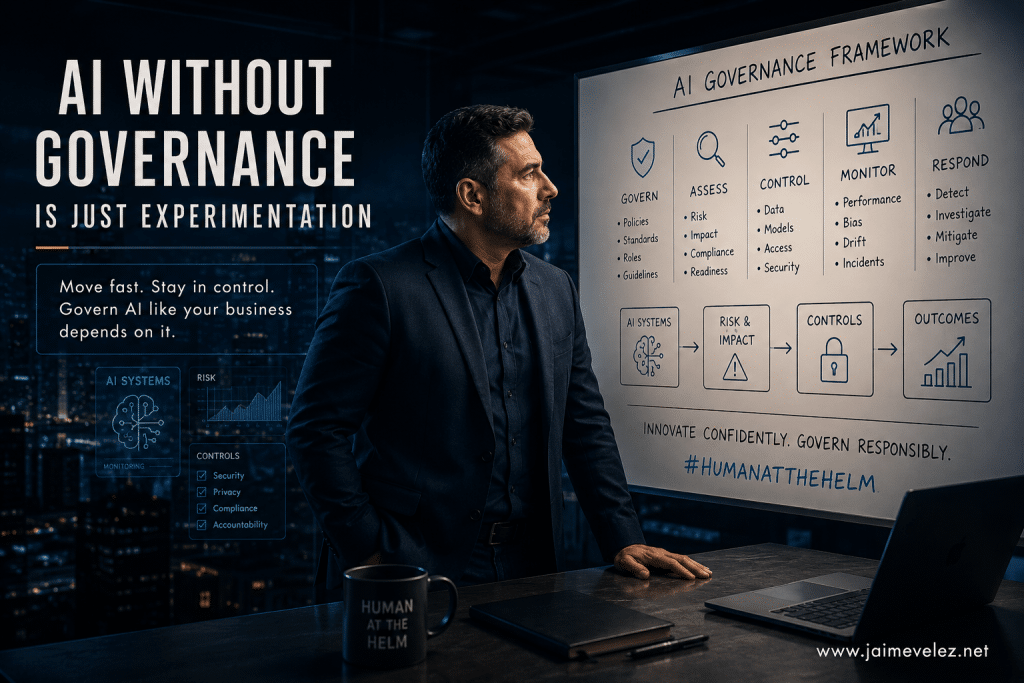
Most organizations cannot distinguish between the layers that exist to defend the pyramid and the layers that exist to defend the institution.
Delete them indiscriminately and you do not get velocity.
You get an audit finding.
Or worse.
The honest version of the transition looks like this:
Before you remove a single layer, you map what that layer actually does.
Coordination? AI can absorb much of it.
Status theater? Eliminate it gladly.
Duplicative approvals that exist because nobody trusts the data? Fix the data.
But control, oversight, decision authority, and accountability?
Those functions do not disappear in a mesh.
They have to be deliberately redesigned into it.
Decision rights made explicit instead of implied by title.
AI agents treated as actors in your control environment, with the same observability, logging, access governance, and change control you would demand of any human or system with production access.
Judgment assigned to named humans, with the mesh making it visible instead of burying it three layers deep.
That is the difference between flattening and governing.
People at the Edge, Humans at the Helm
Block’s essay says something important about the human role in this new model:
“The people are on the edge.”
That is the right image.
But in a regulated enterprise, the edge cannot mean the margins.
The edge is not where humans go after the important work has been automated.
The edge is where the model meets reality.
It is where the system encounters ambiguity, judgment, ethics, trust, power, politics, fear, customer nuance, employee anxiety, and consequences that cannot be reduced to a confidence score.
That is why the edge is not a lesser place.
It is the helm.
The human does not stay at the helm by pretending AI is just a tool.
The human stays at the helm by designing where AI can act, where it must ask, where it must stop, and who is accountable when the system moves.
In the Org Mesh, human judgment is not sprinkled on top after the automation is finished.
It is engineered into the operating model.
That means named accountable owners.
Clear decision thresholds.
Escalation paths.
Controls around agentic behavior.
Visibility into AI-generated recommendations.
Evidence trails.
Human review where the cost of error is high.
And the humility to admit that some decisions should not be delegated to a machine, no matter how impressive the demo was.
The future of work is not humans versus AI. Like I wrote back in May of 2025, Human-AI Teamwork is the new superpower of modern work.
It is humans designing the boundaries of AI inside systems that move faster than hierarchy ever could.
That is Human at the Helm.
Not as a slogan.
As architecture.
Capabilities Replace Departments
There is another idea in Blo