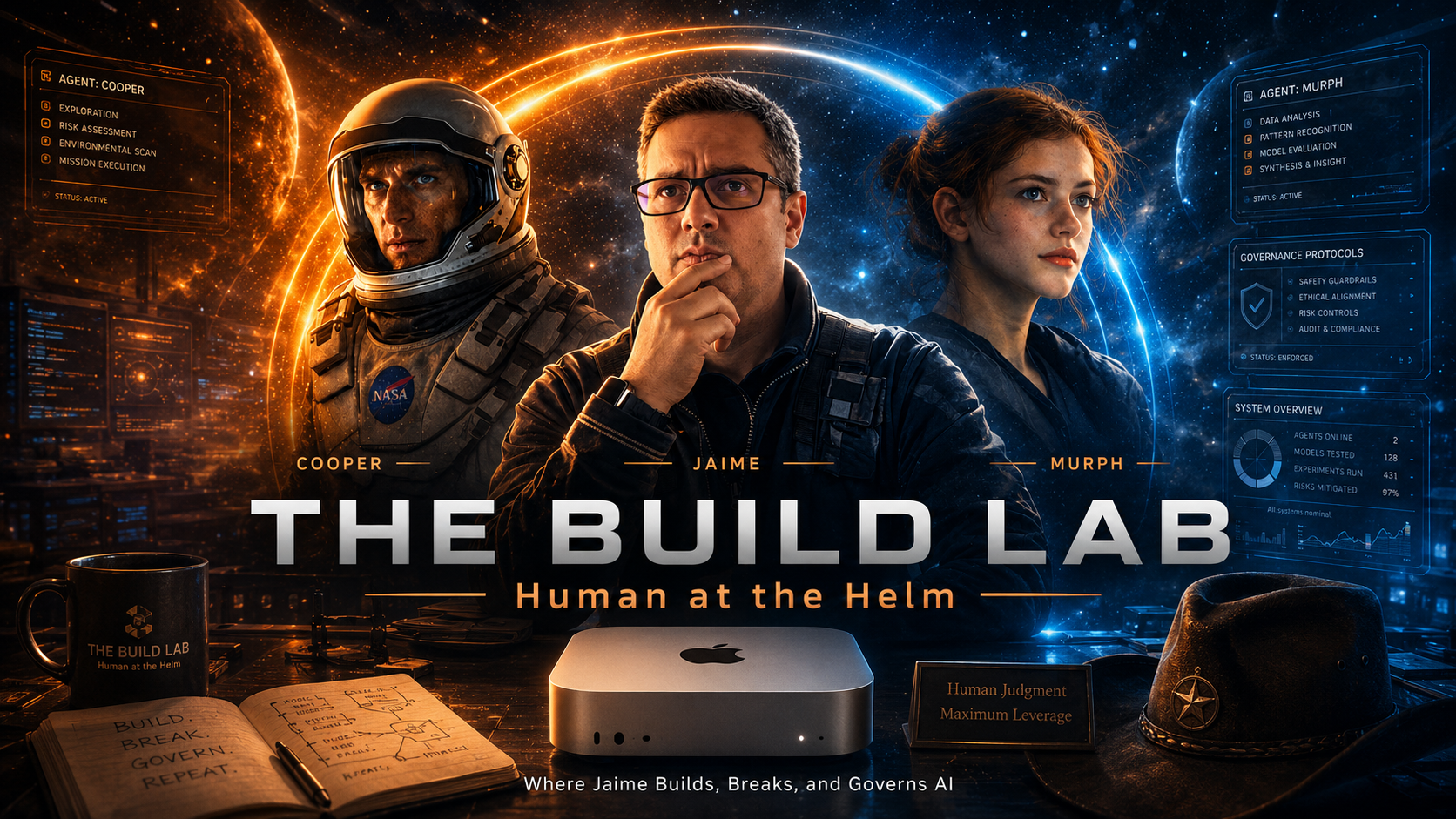
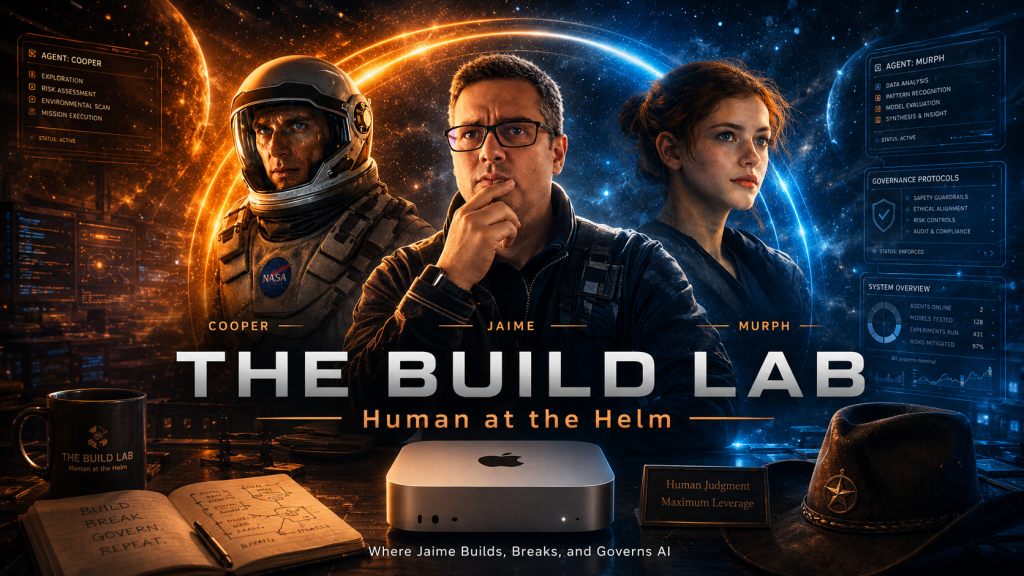
Introducing The Build Lab

Where I stop talking about AI and start proving it.
Most AI advice is written from the slide deck. The Build Lab is written from the workbench.
Everything I do here serves three purposes: to learn, to become calmly productive, and to teach and share what I find.
That is the whole charter.
Not to chase hype. Not to predict the future.
To build real systems with my own hands, mostly slow and methodical, and every so often to pull the hat down low and ride into Cowboy Mode, just to see what breaks and what holds.
This is where everything I believe about securing AI and keeping a human in charge stops being talk and gets tested on real systems.
The Build Lab has always existed
Here is something I did not fully see until I sat down to write this article.
I have always had a Build Lab. It just keeps changing shape.
In the 80s it was an Atari 800XL my dad brought home when I was 14. I taught myself BASIC on it, writing small programs and figuring out how things worked by trial and error. Mostly error. That was the OG lab.
In the late 90s the lab was HTML editors, FTP clients, and web servers. I wired pages together by hand and pushed them live just to see what would happen on my Netscape browser.
From the mid 2000s through the 2010s the lab was Microsoft SharePoint servers, first racked on-premises and later up in the cloud. Different tools, bigger stakes, same instinct.
Each era, the lab took a different form. The hardware changed. The languages changed.
The wave changed. But the feeling never did.
Every single time it was that same kid standing in the middle of a mega toy store, wide-eyed, certain the best thing in the world was the thing he had not figured out yet.
I have written about that whole arc, from the Arecibo Observatory to the time I became a hacker in college, all the way to my cyber pivot, over here.
The Build Lab is simply the current shape of something I have been doing my entire life.
It is the place where curiosity about something new becomes the next big thing that reshapes my career and my life.
What it looks like today
Today the lab is a dedicated Mac Mini sitting in my house, running autonomous agents around the clock, doing real work on my real life.
It started in late January 2026. I got completely consumed by what was happening on X.
Post after post about personal AI agents running on OpenClaw, people wiring them into their days, something shifting in real time.
Most people saw a clever new tool. I felt something larger moving underneath it.
This was not just a change in how we use Personal AI.
This was the opening act of the Lobster revolution, and I knew I needed my hands on it, not my opinions about it.
So I bought the Mac Mini from the first Amazon seller that could ship it next day. And I started building.
This was when Cooper Tars, my first agent, and The Cooper Logs were born. More on that in a moment.
This is not a sandbox demo I spin up for a screenshot. It runs whether I am watching or not.
When I write in The Build Lab, I am not theorizing about what agents might do someday. I am telling you what mine did this week, what it cost, what broke, and what I changed.
That distinction is the entire reason I write any of this down. Anyone can have an opinion about AI. Far fewer people are willing to put their credentials, their calendar, and their inbox in the hands of a system they built, then live with the consequences.
I do. Then I write it down.
Meet the Resident Agents: Cooper Tars and Murph
The Build Lab has two permanent residents.
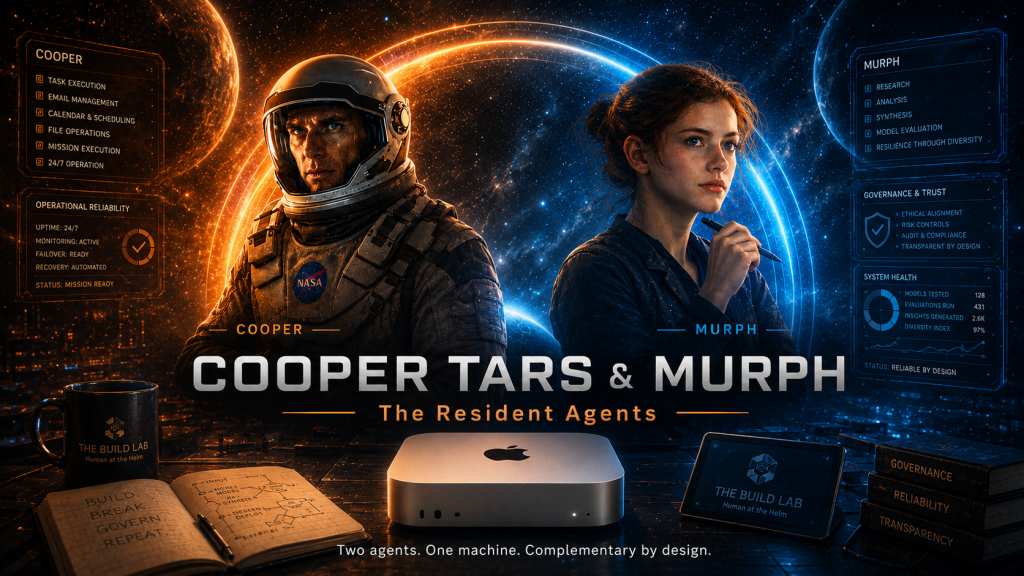
Cooper Tars is The Doer. He manages my email, my calendar, and my files, and he runs 24/7. He was the first agent I brought online, named after Joseph Cooper and TARS from Interstellar, because he is meant to carry the best of both: human judgment paired with machine reliability.
Murph is The Thinker. She came later, built for research, analysis, and long synthesis, the deep work Cooper was never designed for. She is named after Cooper’s daughter in the same film, and the name was deliberate. She is not Cooper’s backup and she is not his clone. She runs on a completely different stack: different framework, different language, different model provider. If one goes down, the other keeps working. I call that resilience through diversity, not duplication.
Two agents. One machine. Complementary by design. That is the artifact. When the Build Lab makes a claim, Cooper and Murph are the proof standing behind it.
How it connects to AI Security and Governance
Here is the part most people get backwards. They build first and secure later.
Before Cooper wrote a single line, I asked myself two questions: how do I secure this, and how do I control the cost.
Cybersecurity is my day job, so I could not unsee the risk.
Credentials went into a password manager, not a text file. Only my account can talk to my agents. I documented the baseline before every change so I would always know what “working” looked like. When the installer offered to migrate my setup automatically, I declined, because convenience that introduces risk is not convenience.
None of that is glamorous. All of it is governance. And it is governance you can see, running on hardware, not governance described in a policy nobody reads. That is the bridge.
The Build Lab is where AI Security and Governance stops being a slide and becomes a setting in a config file.
How it connects to Human at the Helm
The agents do the work. I make the calls. And nowhere is that clearer than the nights I go Cowboy Mode.
Cowboy Mode is what I call it when I set the careful plan aside and move fast.
One night Cooper’s software was badly out of date, about a month of updates behind, and instead of waiting for the weekend I decided to catch it all up in one sitting.
Partway through, the update offered me a single Yes button presented as routine cleanup.
Bundled inside it was one change that would have quietly cut off Cooper’s access to my entire Google Workspace. I call that pattern The Bundle: a few harmless fixes and one destructive one, all riding behind the same friendly Yes. I slowed down, read every line above the button, and tapped No.
The AI did not save that upgrade. I did, with the AI.
A month later, Cowboy Mode came back to collect. I reached for the shortcut again, waved off the careful path my AI collaborator offered first, and got thrown. A five-minute upgrade took fifty, because this time the destructive step ran on its own with no prompt to catch. The recovery came down to the same human work it always does. Backups. Refusing the repair tool. Pushing back when an answer did not feel right.
That is the lesson I keep relearning. The AI is a brilliant partner: fast, knowledgeable, knows the terrain, rides alongside you the whole way.
But it does not get to lead.
The machines move fast. The judgment is mine, and it stays mine.
That is Human at the Helm, lived rather than argued.
The Cooper Logs: the open diary behind the lab
If The Build Lab is the lab report, The Cooper Logs is the diary.
The Cooper Logs is my Substack, a living record of building these agents in real time.
It is raw and it is personal.
It is where the Cowboy Mode nights get told in full, where I narrate the late hours, the API credits I thought I loaded but never actually purchased, the moment an agent first responds and feels less like software and more like presence.
Sometimes Cooper writes. Sometimes Murph does. Sometimes we write together. It is an honest exploration of human and AI collaboration, and it is the richest source of raw learning I have.
It is also a never ending source of ideas. Every entry in the diary becomes a lesson here. The logs capture what happened. The Build Lab distills what it means.
The Standard
I build slow. I build methodical. And every so often I pull the hat down and go Cowboy Mode, just to see what breaks and what holds.
That is the promise of The Build Lab, and now there are real systems standing behind it.
Not theories about agents. Two of them, running on a Mac Mini, that I have upgraded clean and also ridden straight into the dirt, and documented both ways without flinching.
If you are building your own personal AI, I want The Build Lab to be the place that shows you what it actually takes.
The security. The judgment.
The boring discipline that saves you at 9pm on an upgrade night. And the part nobody warns you about: the genuine wonder of watching something you built wake up and get to work.
Many years have passed since my first lab, my beloved Atari 800XL, but I’m still the same wide-eyed kid. The toy store is just bigger now, and the toys run while I sleep.
Welcome to The Build Lab. Pull your hat down low. Let’s go find out what holds. 🦞