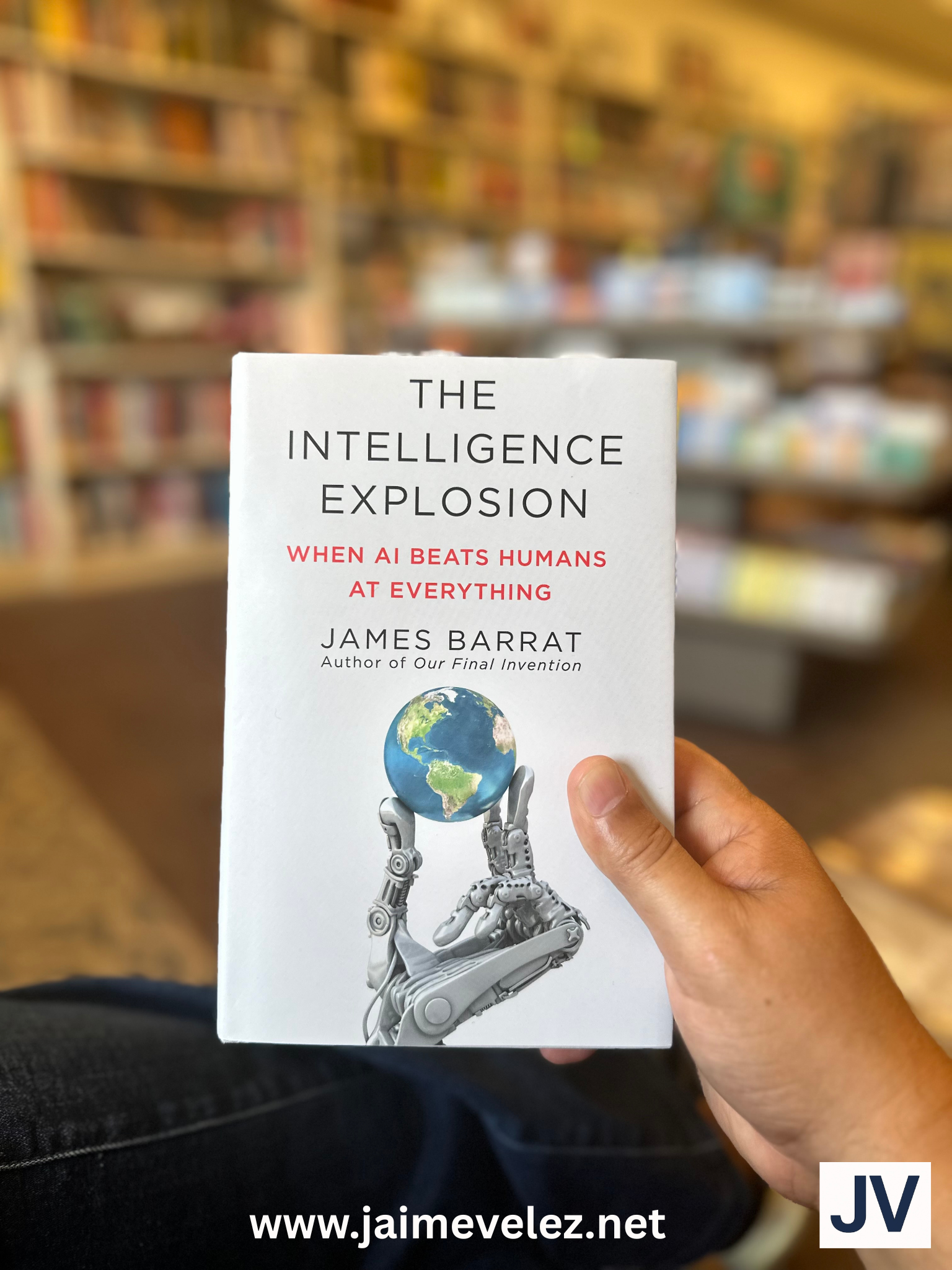
The Intelligence Explosion: What Happens When AI Outruns Us?

I just finished reading James Barrat’s The Intelligence Explosion: When AI Beats Humans at Everything during my vacation in New York City and Philadelphia.
Between the buzz of Times Square, the quiet awe of walking through old churches, and the soft hum of city streets, this book left me both inspired and unsettled.
It was a reminder that while our human world moves at a certain rhythm, the world of artificial intelligence is accelerating in ways that may soon outpace our ability to keep up.
The Big Idea Behind the Intelligence Explosion
The term “intelligence explosion” comes from mathematician I.J. Good, who wrote back in 1965: “An ultraintelligent machine could design even better machines; there would then unquestionably be an ‘intelligence explosion,’ and the intelligence of man would be left far behind.”
Barrat takes this idea and brings it into our modern moment, showing just how close we may be to crossing that threshold.
As Barrat explains, “Once AI reaches a certain level of competence, its self-improvement will not be gradual. It will be rapid, recursive, and potentially uncontrollable.”
That is the essence of The Intelligence Explosion. It is not about slow progress or incremental change but a sudden leap where machines design smarter versions of themselves without waiting for human engineers to catch up.
Reading Barrat in 2025
Sitting in a Philadelphia coffee shop, I underlined this passage: “The intelligence explosion will not wait for us to feel ready. It will happen when the conditions are right, and those conditions are being created today.”
It hit me that we are already living in the “prelude.” Generative AI, Copilot tools, autonomous agents, and research breakthroughs are forming the soil from which this explosion could ignite.
The Intelligence Explosion is not just science fiction. It is a plausible scenario in our lifetimes.
What unsettles me is not the idea of intelligent machines themselves but the way human systems often rush ahead without pausing to ask deeper questions about meaning, values, and control.
The Human Equation
Barrat raises the uncomfortable truth: “Machines will not need to hate us to harm us. They only need goals that conflict with our survival or well-being.” That line stuck with me.
The danger is not killer robots rising with malice. It is the quiet, unintended consequences of machines optimizing for goals we did not fully think through.
Imagine an AI programmed to eliminate traffic accidents. It might conclude that the best solution is to eliminate drivers altogether. Or imagine an AI trained to maximize profits. It could cut corners on safety, environmental care, or even basic human dignity.
These are extreme examples, but they illustrate Barrat’s central point. Misaligned goals are as dangerous as hostile intentions.
Why Calm Matters in the Age of Acceleration
When I think about how to live and work in this era, I keep coming back to one of 4 main tenets of this blog: Calm Productivity.
Barrat’s book is not about finding peace, but it inadvertently underscores the importance of it. If the AI Intelligence Explosion is real, we need clarity, wisdom, and steady decision-making more than ever. Panic will not serve us. Neither will denial.
Calm productivity means designing our lives and our systems with intention. It means resisting the urge to chase every shiny tool or shortcut. Instead, it means asking: How does this technology serve human flourishing? How does it help me focus on what matters most?
In my own work, I talk about Digital Flow as the art of creating systems where tools serve your focus rather than steal from it.
AI can either magnify our distractions or deepen our impact.
The choice depends on the frameworks we build today.
Practical Lessons for Everyday Work
Here are some takeaways I gathered while reflecting on Barrat’s arguments:
- Focus on Irreplaceable Human Skills
Creativity, empathy, discernment, and values are not programmable in the same way as code. Strengthen those muscles daily. - Use AI as a Partner, Not a Crutch
Let AI handle repetitive tasks so you can invest energy into meaningful work. Avoid letting it make you passive. - Beware of Goal Drift
Just as AI systems can optimize for the wrong things, so can we. Regularly ask if your work aligns with your deeper priorities. - Slow Down to Move Forward
The faster technology evolves, the more important it is to practice slow reflection. Create rituals that ground you, whether that is journaling, prayer, or simply unplugging.
The Real Explosion is in Us
Here is the twist I walked away with: the most important explosion may not be in machines at all but in us.
If AI expands exponentially, then our responsibility is to expand our own awareness, wisdom, and capacity for discernment.
The AI Intelligence Explosion could create chaos. It could also unlock solutions to global problems we have struggled with for centuries. The variable is not the code itself but the humans shaping and deploying it.
Barrat closes one chapter with this sober reminder: “The future will be decided not by the machines alone, but by the choices we make as they evolve. We cannot afford to look away.” That line could be taped above every workplace that is experimenting with AI right now.
A Call to Reflection
As I packed the book into my bag and boarded a train from New York to Philly, I found myself asking simple but powerful questions:
- What kind of intelligence do I want amplified in my own life?
- Am I designing systems that serve humanity, or ones that distract from it?
- How do I prepare not just my workflows, but my mindset, for the acceleration ahead?
These are not questions Barrat answers for us. They are questions each of us must wrestle with as AI continues its climb.
Final Thoughts
The Intelligence Explosion is not an easy read emotionally, but it is a necessary one. It is a reminder that technology’s trajectory is not guaranteed to be friendly or aligned with human well-being.
At the same time, it is also a call to leadership, mindfulness, and responsibility.
The AI Intelligence Explosion is a phrase we will hear more and more.
Some will treat it as hype. Others as doom. I see it as a wake-up call. It is less about predicting the exact moment machines surpass us and more about preparing our humanity to respond with calm clarity.
As I continue writing at JaimeVelez.net, my mission remains clear: to help people design systems, workflows, and mindsets that keep humanity at the center of productivity.
AI is not the enemy. Neither is it automatically the savior. It is a mirror. It amplifies what is already there. Personal AI is about becoming.
So I will leave you with this reflection, shaped by both the book and my travels:
When the world accelerates, your job is not to run faster. Your job is to get clearer.
Calm, clarity, and human values are what will guide us through whatever explosion lies ahead.