What is Intelligence in the Age of AI?

A Human-First Redefinition
If you asked most people to define intelligence, you would get a familiar answer: the ability to acquire and apply knowledge and skills.
That definition is not wrong. It is just incomplete now.
Because we have entered a world where the acquiring part has been supercharged.
AI can retrieve, summarize, translate, and generate at speeds no human brain can match.
What used to take hours now takes minutes. What used to require years of memorization now requires a good question and a calm mind.
So it is time to redefine and reimagine intelligence.
If you have felt a strange pressure lately, like the definition of “smart” is shifting under your feet, you are not imagining it.
Intelligence in the Age of AI is changing the rules in real time.
This is a pillar post about Intelligence in the Age of AI. It is an invitation to stop confusing intelligence with memorization, stop confusing work with motion, and stop confusing performance with meaning.
Knowledge is static. Intelligence is dynamic.
Let’s unpack that.
Knowledge is what you know. It is a library of facts, models, stories, and experiences.
Intelligence is what you do with what you know.
It is the living capacity to notice what matters, learn what you need, apply it in context, and produce something useful from it.
In the past, the world rewarded knowledge hoarding.
The person who remembered the most often looked like the smartest person in the room.
Unfortunately, many people today are still living in the past.
Today, that advantage is evaporating.
Your “external brain” is everywhere: books, search, and now AI systems that can recall more than any human ever could.
Which means the question has changed.
It is no longer, “What do you know?”
It is, “What can you produce?”
Intelligence in the Age of AI is a daily practice, not a label.
When Intelligence Meant Knowing Things, and When It Meant Deciding What to Do
For most of our lives, intelligence has been defined in academic terms.
It meant acquiring knowledge, mastering skills, and proving what you know.
But there has always been another meaning of intelligence running quietly alongside it.
In the military and political world, intelligence is information of strategic value. It is what you gather, synthesize, and act on to reduce uncertainty and make better decisions.
In that world, intelligence is not trivia. It is not credentials. It is decision support.
You can see this strategic definition at work in the modern tech landscape.
Palantir, for example, built platforms like Gotham that help organizations integrate data, see patterns, and make decisions in complex operational environments.
I am not bringing this up to praise or condemn any company. I am bringing it up because it clarifies the point: intelligence is not the database.
Intelligence is the insight that reduces uncertainty and guides action, ideally with human judgment at the helm.
That definition fits modern life surprisingly well.
Most of us are drowning in information. We are surrounded by dashboards, calendars, files, chats, and endless open tabs.
We have more knowledge than ever.
Yet many of us feel less clear than ever.
That is the paradox of Intelligence in the Age of AI.
Access has exploded, but meaning has not.
So intelligence must evolve.
Why memorization is not intelligence anymore
Let’s say the quiet part out loud.
Memorization is impressive, but it is not the same thing as intelligence.
Memorization can support intelligence, the way tools support craftsmanship.
But tools do not build anything by themselves.
For years, school and corporate life rewarded the appearance of intelligence: perfect recall, confident answers, the right buzzwords at the right moment.
But in a world where AI can recall anything on demand, that advantage shrinks fast.
If your definition of intelligence is “I can remember more than you,” you are competing with a machine that never forgets.
That is not a fair fight, and it is not the point.
Intelligence is acquiring and applying knowledge, and it is acquiring and applying skills.
AI is amplifying acquisition faster than anyone could have imagined.
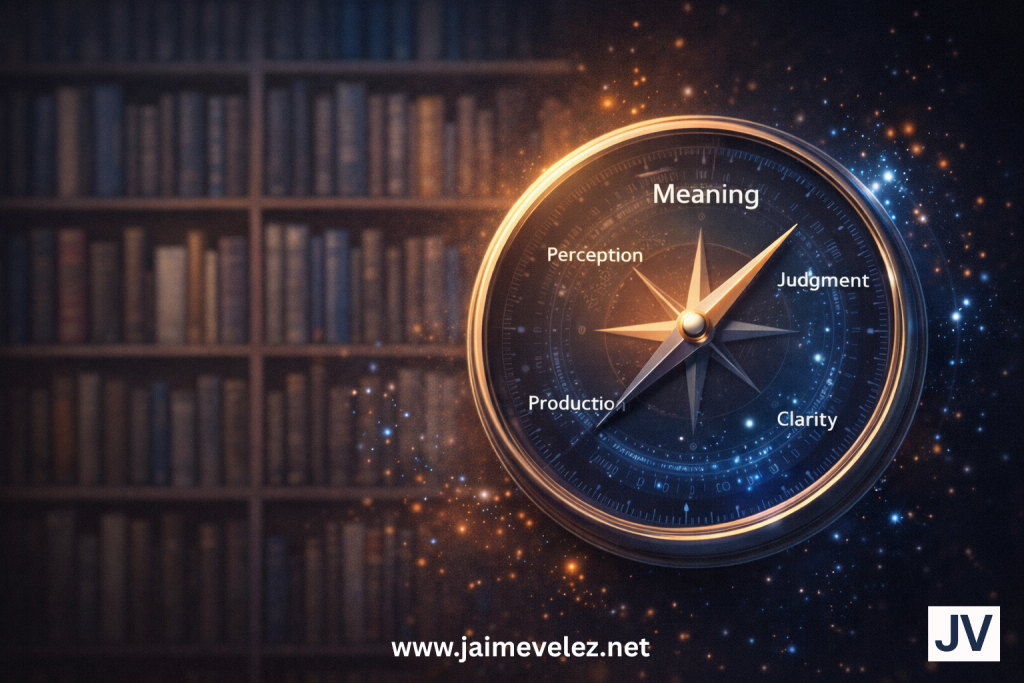
Which means the human edge is shifting toward discernment, judgment, context, and purpose.
The Rise of Performative Intelligence and Corporate performance theatre
Now we need to talk about the trap.
In the corporate world, there is a form of intelligence that looks smart, sounds smart, and often gets rewarded. But it does not produce much.
It is what I call: Performative Intelligence.
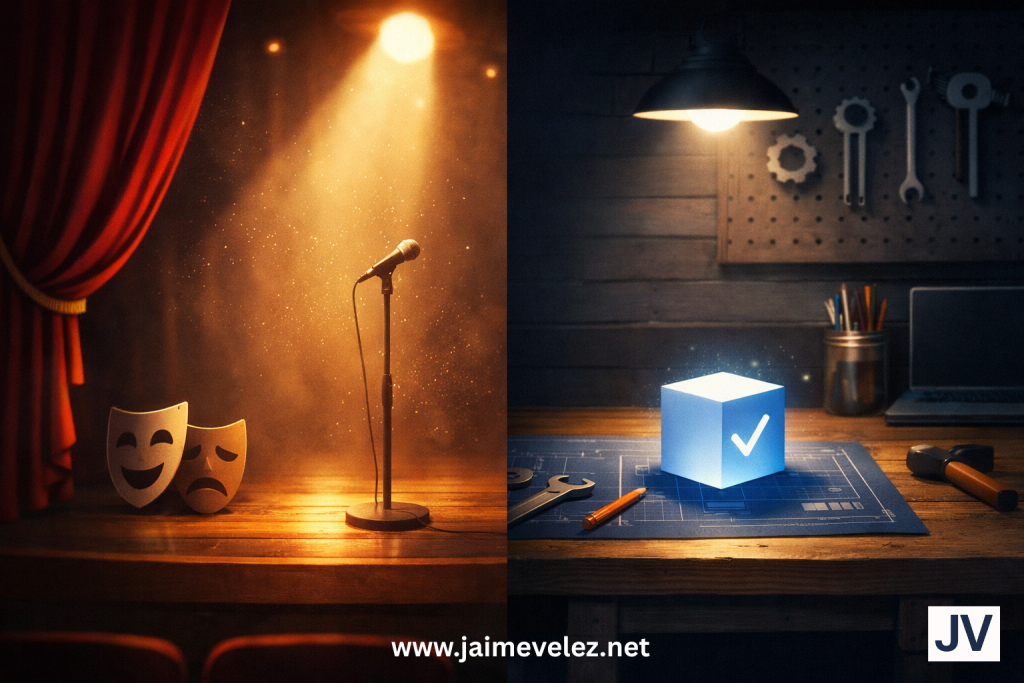
Performative Intelligence is when you optimize for looking competent instead of becoming capable.
I can just visualize many of you raising your eyebrows right now. You know exactly what I’m talking about.
It is when you collect frameworks like souvenirs, but never build anything with them.
It is when your calendar is full, your mind is tired, and your soul is quietly asking, “What did I actually accomplish today?”
Corporate life can be full of performance theatre.
Not because people are evil, but because systems reward visibility.
They reward certainty. They reward being “in the loop,” even when the loop is just spinning.
William Shakespeare captured the spirit of this centuries ago: “All the world’s a stage, and all the men and women merely players.” That line is from As You Like It, spoken by Jaques.
It is a brilliant observation. It is also a warning.
Because if the world is a stage, you have to decide what kind of actor you want to be.
There is a version of work where you perform all day and produce nothing.
You speak in polished sentences, you nod at the right moments, you trade slides and statuses, and you go home exhausted.
And if you are honest, you do not sleep that well.
Not because you worked hard, but because your nervous system knows the difference between real contribution and rehearsed performance.
Here is the contrarian question, asked gently:
If your work is mostly performance theatre, is it meaningful work?
I am not asking you to hate your job. I am asking you to audit your reality.
When you finish a day of work, do you feel the quiet satisfaction of having built, helped, or moved something forward?
Or do you feel like you played a part?
The age of AI is going to make this harder to ignore.
Because AI can generate the performance too. It can write the email, draft the summary, create the slide deck, even mimic the tone.
So the value of the performance will drop.
And the value of real production will rise.
This is the moment where intelligence stops being theoretical and starts becoming personal.
From doing to producing
For years we have confused work with doing.
We celebrate the grind, the long hours, the packed schedules. We measure commitment by exhaustion.
But what is the real value of work?
Is it to be busy, or is it to produce?
Production is not just output. Production is meaningful output. It is work that changes something.
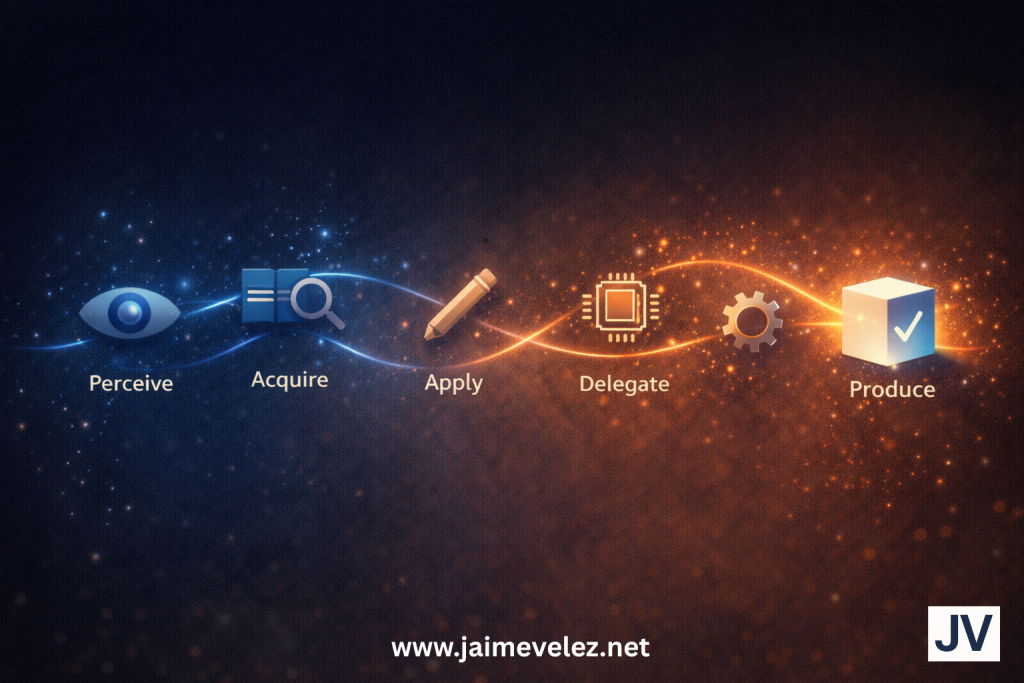
This is why AI is not just a productivity tool. It is an intelligence amplifier.
It helps you acquire and apply knowledge and skills faster.
But it also exposes whether you know what you are trying to produce.
AI can do more of the doing, but it cannot decide what is worth doing in the first place.
That is still on you.
Three quick moments that taught me this
First, I felt it on a trip this past fall between New York City and Philadelphia while reading James Barrat’s The Intelligence Explosion on the train.
The buzz of Times Square made everything feel urgent.
The quiet of old churches in the suburbs of Philly made everything feel true.
Somewhere between those two places, it hit me: when the world accelerates, your job is not to run faster. Your job is to get clearer.
Second, I learned it the fun way.
You cannot jam with a band if everyone is out of sync. Trust me, I have done it.
Working with AI is similar.
If you treat it like a vending machine, you get junk. If you treat it like a teammate, you find rhythm.
Third, I learned it the honest way.
I have started and stopped many blog publications before. More than once.
Starting is easy. Announcing is easy. Shipping is the real work. Production is the proof.
Those three moments point to the same conclusion:
Intelligence in the Age of AI is not about having more information. It is about directing attention and effort toward what matters.
The intelligence that matters most now
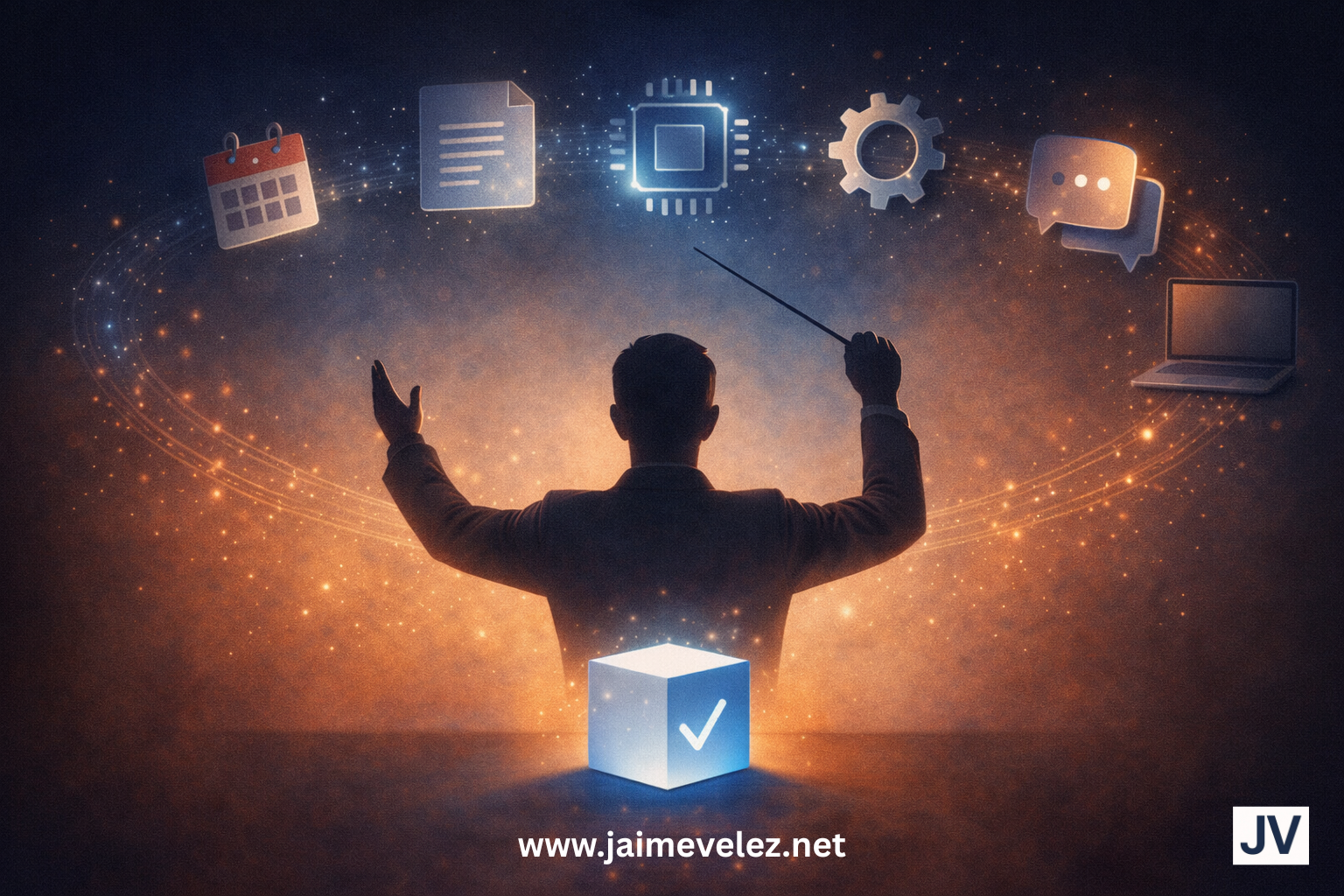
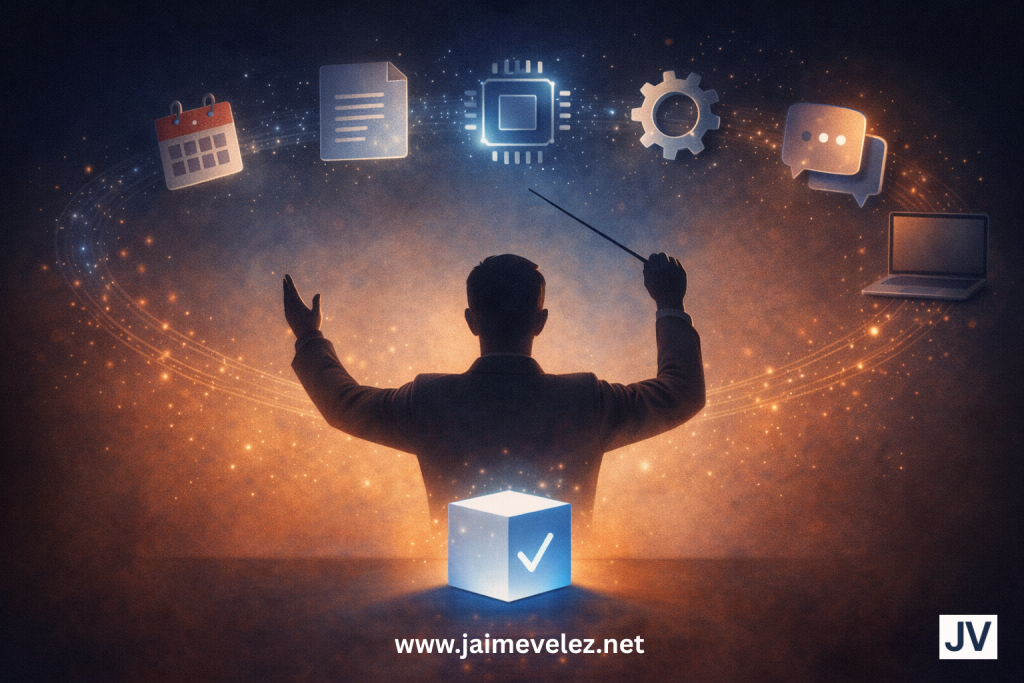
In this era, intelligence is less about doing tasks and more about orchestrating outcomes.
It is the capacity to ask better questions, set better constraints, choose better priorities, delegate wisely, and create meaningful outputs.
This is why I keep writing about Human-AI Teamwork and the AI Mindset.
Human-AI collaboration is already here, and the real differentiator is leadership, not tech bravado.
Your job is no longer just to do the work.
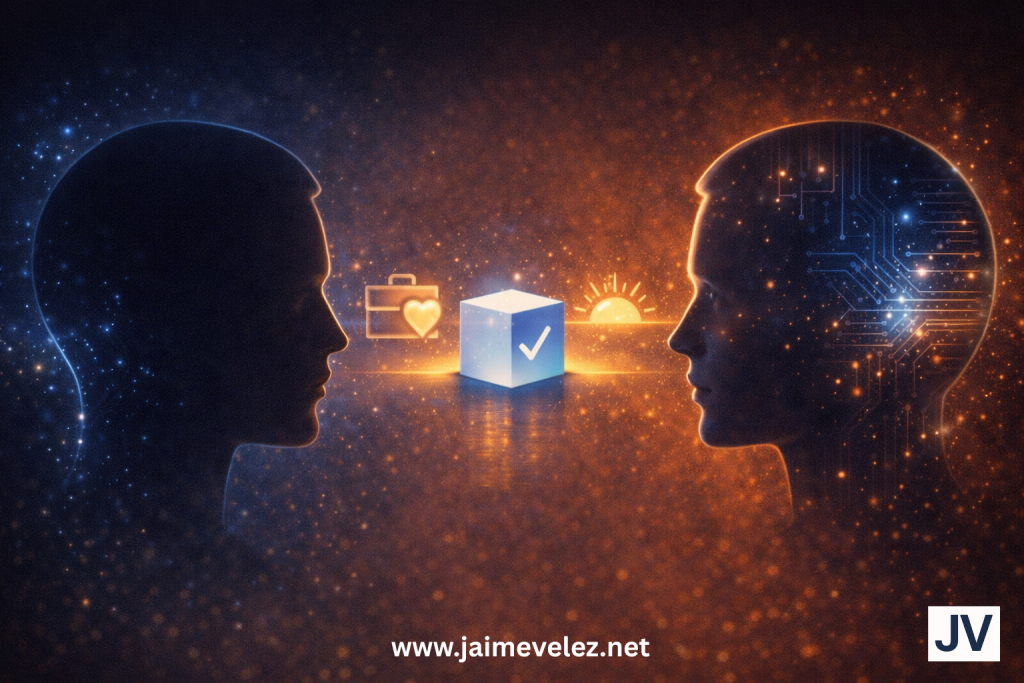
Your job is to direct, design, and dialogue with machines.
Your job is to become an Agent Boss.
But here is the catch.
If you do not know what your meaningful work is, you will use AI to accelerate the wrong things.
You will become faster at tasks that do not matter.
You will produce more noise.
You will scale your confusion.
That is why Intelligence in the Age of AI has a moral dimension.
Intelligence without purpose produces noise. Intelligence aligned to meaning produces value.
A human-first redefinition
So let’s put the new definition on the table, in plain language.
Intelligence in the Age of AI is the ability to acquire and apply knowledge and skills, and to direct that capability toward meaningful outcomes.
Not memorization.
Not credential collecting.
Not performance theatre.
Direction.
Application.
Production.
This is also where your Life’s Work enters the room.
Meaningful work is the north star for intelligence. It tells you what to learn, what to build, what to delegate, and what to ignore.
Without that north star, you drift, and AI helps you drift faster.
A call to action that lands
Stop trying to prove you are intelligent.
Start building a life where your intelligence produces something that matters.
This week, audit your work:
Where are you performing?
Where are you producing?
Ask yourself:
- What did I create that did not exist before?
- What did I improve, simplify, or clarify for someone else?
- What did I remove that was wasting energy?
- What did I delegate to machines so I could do more human work?
- What would still matter to me even if nobody applauded?
Then do the brave thing.
Get clear on your Meaningful Work, and redefine intelligence in the pursuit of your Life’s Work.
If you want an on-ramp, start with my post What is Meaningful Work, Anyway?
Then revisit Human-AI Teamwork and The AI Mindset to build the collaboration muscle that modern work now requires.
Read The Intelligence Explosion (or read my post summary of the book) and remember the twist: the real explosion is not only in machines, it is in us.
And close the loop with reading my very first post on this blog, Creating Your Life’s Work, because that is where intelligence becomes personal, calm, and aligned.
The promise of AI is not to free us from work. It is to free us for meaningful work.
That is the human-first redefinition.
If this post did its job, you will walk away with a new question in your pocket, one you can carry into Monday morning meetings and Friday night reflections: Am I practicing Intelligence in the Age of AI, or am I just performing competence?
That is Intelligence in the Age of AI.