Enough with the AI Fear-Mongering: Change is Coming but Not by Christmas

AI fear is everywhere.
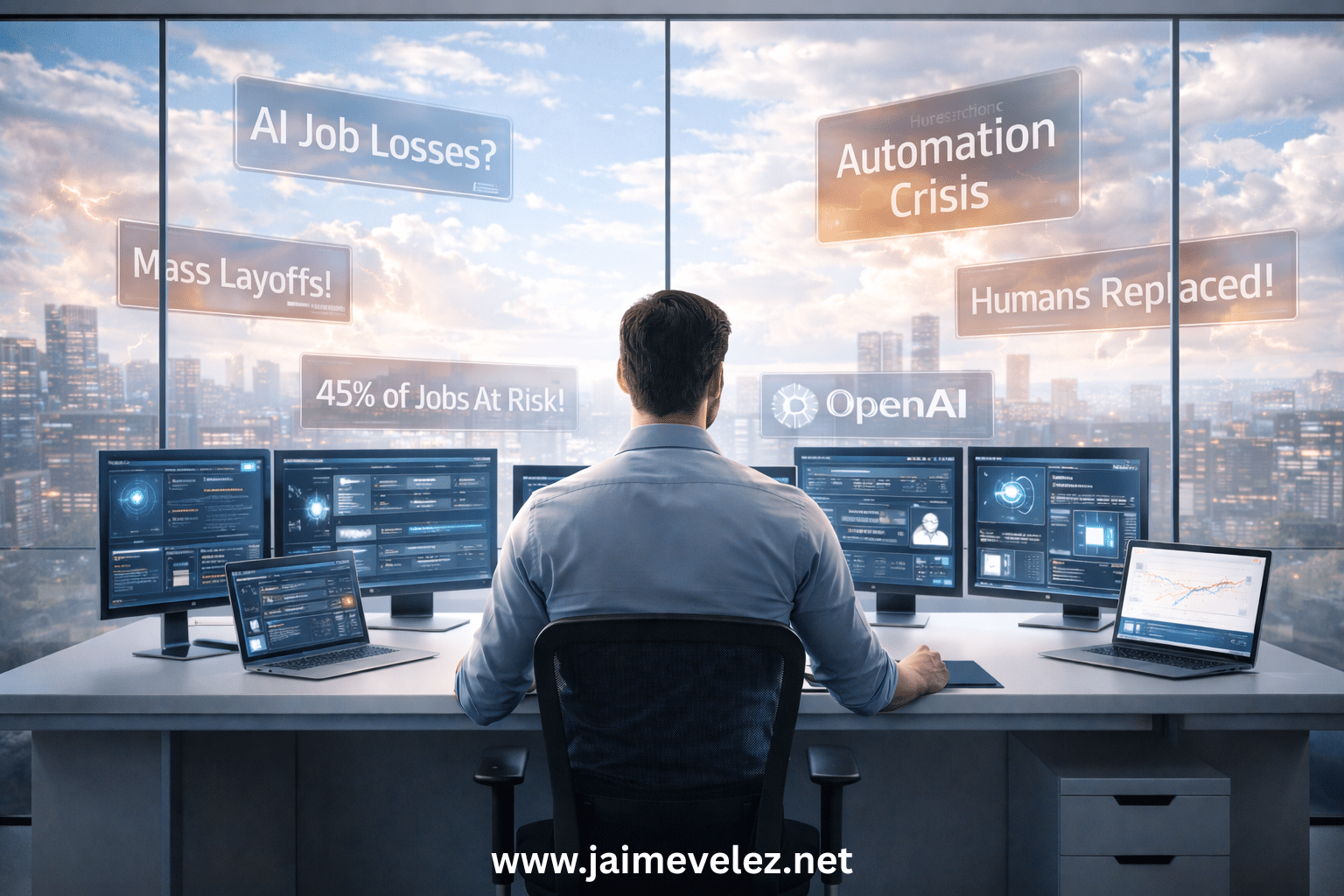
Every few days, another post shows up warning that AI is about to wipe out entire categories of work overnight.
The tone is always the same.
Panic now. Adapt immediately. Everyone is doomed except the people who discovered the newest tool last Tuesday.
I understand why these messages spread.
They are dramatic. They are emotional. They make people stop scrolling. They also tap into something very real. Many professionals can already feel the ground shifting beneath them.
This is particularly true for mid-career professionals. AI is changing how we work, how fast we work, and what kinds of work will still matter.
That part is true.
In fact, I recently read a LinkedIn post where professionals were openly discussing retiring early just to avoid having to deal with AI altogether. That is how deep the anxiety runs.
But the nonstop AI Fear narrative is not helping people think clearly. It is making them reactive, distracted, and overwhelmed at the exact moment they need calm judgment the most.
Yes, change is coming.
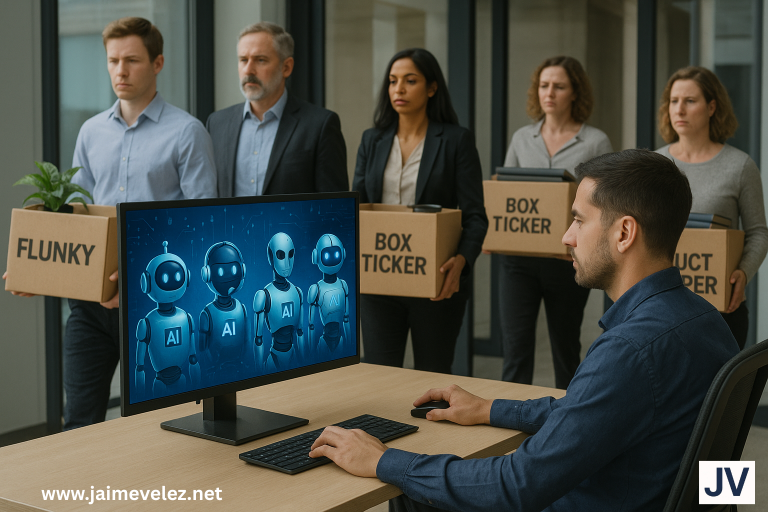
No, most offices are not going to look like abandoned malls by Christmas.
We need a more honest conversation.
The Change Is Real
Let me start there.
AI is not a toy anymore.
I have been in technology for nearly 30 years. I have seen every major wave come through. Cloud. Mobile. DevOps. Digital transformation. None of them moved like this.
The innovations are happening daily. Not quarterly. Not annually. Daily. And each one builds on the last. It is genuinely unlike anything I have experienced in my career.
It is no longer limited to generating clever paragraphs, summarizing meetings, or answering questions with mixed confidence and occasional hallucinations.
We are moving into a new phase where AI systems can take action, complete tasks, coordinate tools, and operate with increasing autonomy.
That matters.
I know because I live with it every day.
I have two AI agents running on my local machine right now. Cooper Tars handles research, writing, analysis, content strategy, and daily operational support.
Murph is newer and focused on a different set of tasks. Both run locally. Both work for me around the clock.
I even gave one of my agents a push-to-talk walkie-talkie so I can communicate with it when I’m not at my computer.
These are not demos. They are not theoretical. They are running on hardware I own, in my home, on my terms.
And once you experience what an AI agent can actually do across real tasks, across real days, you cannot go back to pretending the old model of work is safe and stable.
If you have spent any time working with serious tools, especially agent-style systems, you already know why this feels different. Once you see an AI system draft communications, organize information, navigate complexity, complete structured steps, and keep moving without constant hand-holding, you start to realize how much modern desk work is made up of repeatable patterns.
That realization is uncomfortable.
This is why so many people feel uneasy.
They are not imagining things.
The tools are getting better. The capabilities are expanding.
Companies will absolutely use AI to reduce friction, move faster, and rethink roles that are heavy on routine execution.
That deserves attention.
It does not deserve hysteria.
What the Fear Merchants Get Wrong
The biggest mistake in most AI panic posts is this: they confuse task disruption with total human replacement.
Those are not the same thing.
A role is not just a list of tasks.
A good employee does more than produce outputs. A good employee interprets ambiguity, builds trust, navigates politics, makes judgment calls, notices what others miss, and adapts when reality refuses to follow the playbook.
AI can assist with some of that.
It can even outperform humans in certain narrow areas.
But here is what I have learned from actually running agents every single day: the better Cooper gets, the more my own judgment matters, not less.
The more Murph can handle autonomously, the more critical it becomes that I know what to ask for, how to evaluate what comes back, and when to override.
The human in the loop is not a bottleneck. The human in the loop is the whole point.
Or as I prefer to call it: Human at the Helm.
Not monitoring from the sidelines. Not rubber-stamping outputs. Steering.
Work inside a real organization is messier than the internet likes to admit.
Processes are inconsistent. Data is fragmented. Permissions are a nightmare.
Teams do not align. Leaders change priorities midstream. Systems break.
Customers behave irrationally.
People misunderstand each other in meetings and then pretend they did not.
In other words, real work is not a neat demo.
That is why so much AI Fear feels exaggerated. It assumes that because a model can perform a task in a controlled environment, a company can instantly redesign itself around that capability. Anyone who has worked inside a large organization knows that is not how transformation happens.
Technology can move fast.
Organizations usually move like a shopping cart with one bad wheel.
What Will Actually Happen First
The first wave is not total job extinction.
The first wave is role compression.
Some jobs will shrink. Some teams will need fewer people for the same output.
Some entry-level responsibilities will get thinner. Some managers will expect more leverage from fewer employees. Some workers who used to survive on basic coordination, repetitive reporting, or low-level production will find that the bar has moved.
The first jobs to go will be the “bullshit jobs“.
The roles that existed mostly to move information from one place to another, schedule things that could be scheduled automatically, or produce reports nobody reads. If you have ever sat in a meeting wondering why half the room was there, you already know which roles are on the clock.
That is the more realistic picture.
The pressure will increase first on people whose value is tied almost entirely to procedural work.
If your role depends on doing the same kinds of tasks in the same kinds of ways, AI will likely take a growing share of that work.
But that still does not mean you become irrelevant.
It means your professional value has to evolve.
This is where the conversation should get serious.
Not panic. Serious.
Because AI Fear may be emotionally understandable, but it is strategically useless unless it leads to better thinking.
The Real Shift: From Doing the Work to Directing the Work
Here is what running my own agents has taught me about where professional work is actually heading.
When I first started using Cooper, I used him like a chatbot. I asked questions. I got answers. It was faster Googling.
Then something shifted.
I started giving Cooper structured objectives. Multi-step tasks. Strategic analysis. Content development across formats. Research that fed into real decisions. I stopped treating AI as a question-and-answer machine and started treating it as a system I could direct.
That is when the leverage became obvious.
And that is when I realized: the future does not belong to people who can do the work. It belongs to people who can direct the work.
The modern professional will increasingly need to know how to frame the problem clearly, decide what should and should not be delegated to AI, guide AI systems toward useful outcomes, evaluate quality instead of blindly trusting speed, and combine human judgment with machine leverage. What I call AI fluency.
That is not a small shift.
It is a career-level shift.
And it is exactly why the right response is not fear, but fluency.
Why Calm Professionals Will Have an Advantage
The internet rewards emotional extremes.
But real transformation favors the people who can stay steady.
Those who learn how to develop a calm mindset.
The modern professionals who will navigate this season best are not necessarily the loudest or the most online. They are the ones who can observe reality clearly without spiraling.
They know change is happening, but they do not let AI Fear drive them into tool-chasing chaos.
They are willing to learn. They are willing to experiment. They are willing to let go of old assumptions.
Most importantly, they do not confuse urgency with panic.
There is a difference between moving quickly and moving frantically.
Frantic people collect bookmarks. Calm people build capability.
Frantic people repost every prediction. Calm people test tools in real workflows.
Frantic people obsess over whether AI will replace them. Calm people ask a better question:
How do I become more valuable in a world where AI handles more of the mechanics?
That question changes everything.
What Modern Professionals Should Do Right Now
If you are feeling uneasy, that does not make you weak. It makes you awake.
But do not stop at anxiety.
Use the moment well.
Here is what I would focus on.
1. Learn one serious AI workflow.
Not ten tools. One real workflow.
Pick something meaningful in your day-to-day life or work and learn how to improve it with AI. Writing, research, analysis, planning, content creation, meeting prep, task triage, documentation, reporting, whatever is relevant to your world.
When I brought my second agent into my workflow, I did not try to automate everything at once. I started with one thing: background research tasks that used to eat hours of my week. That one workflow taught me more about AI’s strengths and limitations than any article or course ever could.
You do not need to become an engineer overnight.
You do need firsthand experience.
2. Stop thinking of AI as only a chatbot.
That mental model is already too small.
It is time to think beyond the prompt.
It is time to start thinking of AI as a multi-agent system. Not one tool doing one thing, but multiple agents working in coordination, each with a different role, each handling a different part of the workload.
AI is becoming a layer for reasoning, generating, coordinating, and acting. The people who understand this early will see possibilities others miss.
I run two local agents that serve completely different functions. That kind of architecture thinking, deciding what each agent handles and how they complement each other, is where the real advantage is forming.
It is time to become an AI Agent Boss.
3. Strengthen the human skills that become more valuable under automation.
Clarity. Judgment. Communication. Taste. Trust. Leadership. Discernment.
These are not soft extras.
These are the multipliers.
When machines can produce more raw output, the humans who can define quality and direction become more important, not less.
Cooper can draft ten versions of something in minutes. Knowing which version is right, which voice fits, which angle serves the audience, that is still entirely mine.
4. Build personal leverage.
This matters more than ever.
An audience. A body of work. Your life’s work. A reputation. A set of ideas people associate with your name. A business model outside the narrow logic of a job description.
You do not need to become a full-time creator tomorrow.
But depending entirely on one employer to define your value is becoming a riskier strategy. Let us all be honest about that.
Consider all your options for economic value creation. Your skills, your experience, your perspective, your network. These are assets. Consider a hybrid path. One foot in your career, one foot building something that is yours. That is not disloyalty. That is wisdom.
5. Become the person who helps others adapt.
This is a major opportunity.
The person who can calmly explain the tools, model responsible usage, and help a team adopt AI wisely will become far more valuable than the person who either hypes everything or rejects everything.
I believe this to be my calling. I wrote about it in my own personal manifesto. Not because I have all the answers, but because I have spent enough time in the trenches to know what real adoption looks like versus what looks good in a demo.
Every organization has people who are scared. Every team has people who are curious but do not know where to start. Be the steady hand. That is leverage no AI can replicate.

Entrepreneurship Is Not the Only Answer, But Leverage Is
Some people are saying the future is entrepreneurship because jobs will disappear.
I think that is partly right and partly oversimplified.
Not everyone needs to start a company. Not everyone wants to build a personal brand. Not everyone should quit their job and declare themselves a founder after two weekends with a prompt library.
But everyone should think more seriously about leverage.
Leverage means building something that extends beyond your hours.
It could be a side business. It could be a niche reputation. It could be a content platform. It could be a set of specialized skills. It could be the ability to lead AI adoption inside your company.
The point is not that every person must become an entrepreneur.
The point is that fewer people can afford to remain passive.
We Need Less Panic and More Preparation
This is where I land.
The AI fear is understandable. The exaggeration is not.
We do not need more dramatic declarations that all work is dead by the holidays. We need sober, practical preparation for a world in which work is changing faster than many institutions are ready for.
That means telling the truth in both directions.
Yes, AI will disrupt roles. Yes, some people and companies are underestimating how fast this is moving. Yes, professionals who ignore these tools entirely are taking a real risk.
And also:
No, the sky is not falling next Tuesday. No, humans are not becoming obsolete just because software can now click buttons and draft emails. No, fear alone will not make you future-ready.
What will help is clarity. What will help is experimentation. What will help is learning how to pair your humanity with the right tools instead of competing with the machine on the machine’s terms.
That is the better path.
Not denial. Not panic. Preparation.
The future of work will absolutely be shaped by AI.
But the people who thrive will not be the ones who shouted the loudest about the collapse.
They will be the ones who stayed grounded, learned quickly, and built value that machines could amplify rather than erase.
Enough with the fear-mongering.
Change is coming. That’s for sure.
Just not by Christmas.
And that is good news, because it means there is still time to prepare wisely.
Stop listening to all the AI fear. Start embracing Personal AI instead.
That is your logical starting point.
Start preparing for a better way of working.
A way that makes work more human.