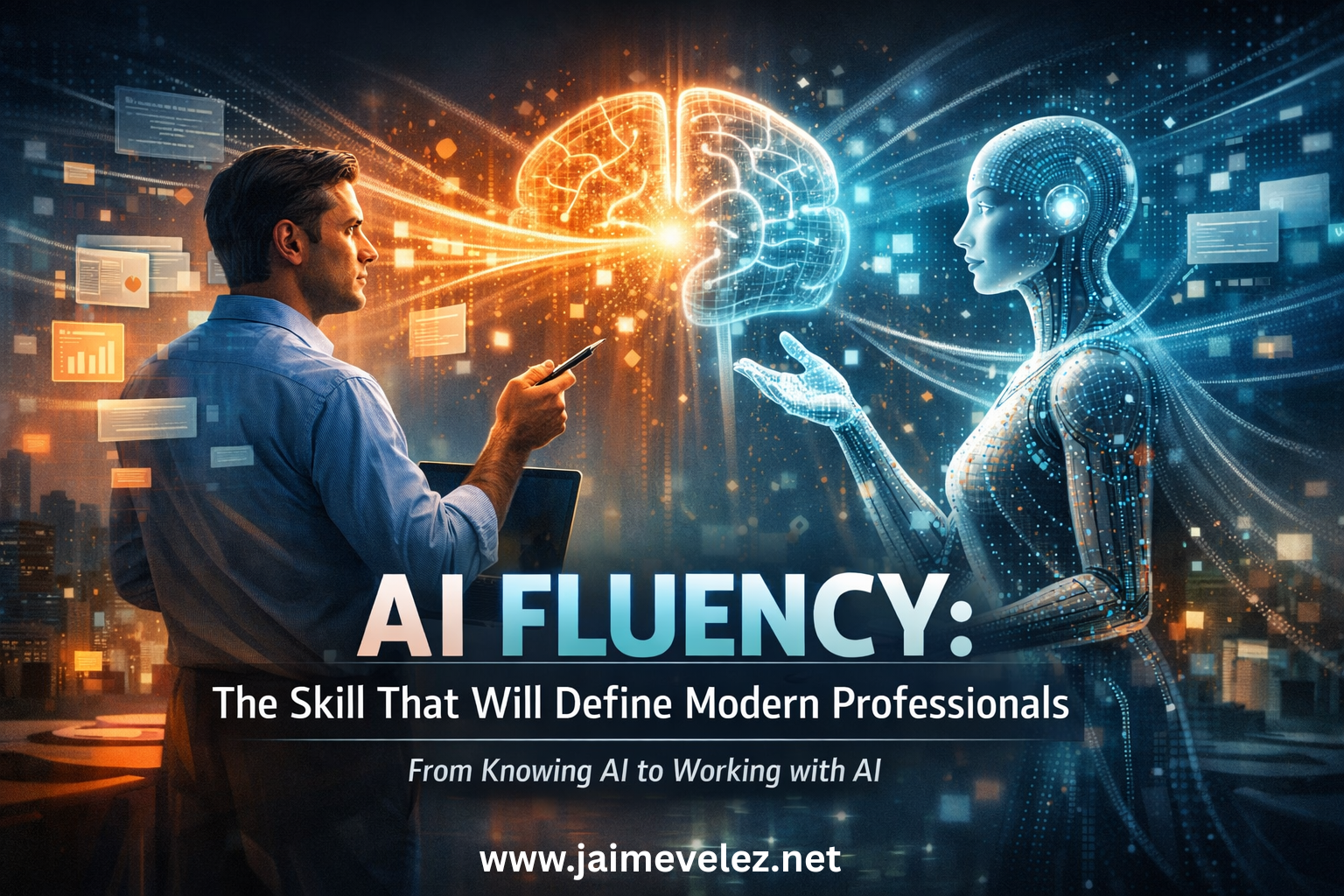
AI Fluency: The Skill That Will Define Modern Professionals

Over the next few years, one skill will quietly separate professionals who thrive from those who struggle to keep up.
It’s not coding. It’s not data science. And it’s not learning every new AI tool that appears on LinkedIn or X.
It’s something simpler.
AI Fluency.
Right now, most professionals are somewhere in the early stages of understanding AI.
They’ve heard about ChatGPT, Copilot, or Claude. They may have tried a few prompts.
Maybe they’ve asked AI to rewrite an email or summarize a document.
In other words, they know AI exists.
But knowing about something is very different from being fluent in it.
Think about languages for a moment.
If I asked you what languages you speak, most people would answer something like:
“I know a little Spanish” or, “I studied French in high school.”
Oui, oui… un croissant s’il vous plaît.
But every now and then someone answers differently.
They say, “I’m fluent in Spanish.”
That word matters.
Because someone who knows a language can recognize a few words. They might remember some grammar rules. Maybe they can follow parts of a conversation if people speak slowly.
But someone who is fluent operates differently.
They can think in the language.
They can solve problems in the language.
They can express ideas naturally, without translating everything in their head.
Fluency changes how you interact with the world.
AI is quickly becoming the same way.
Many professionals today know about AI.
But far fewer are developing AI Fluency.
And that difference is going to define the next era of professional success.
Because the advantage will not belong to the people who simply know AI exists.
It will belong to the professionals who know how to think, work, and solve problems with AI.
What Is AI Fluency?
AI Fluency is the ability to collaborate with artificial intelligence to produce meaningful outcomes. It goes beyond knowing how AI works. It involves framing problems clearly, guiding AI systems effectively, and applying their outputs to real work.
In other words, AI becomes part of how you think, not just another tool you occasionally open.
You begin to see opportunities to use AI everywhere in your workflow, from research and analysis to strategy and decision-making.
Over time, working with AI starts to feel less like using software and more like collaborating with a very capable colleague.
What AI Fluency Actually Looks Like
Think about someone who is fluent in a language.
They do not pause to translate every sentence.
They think directly in that language.
AI Fluency works in a similar way.
Professionals who develop AI Fluency start to see their work differently.
When a task appears, their instinct is to ask:
Can AI help me analyze this?
Can AI help me structure this problem?
Can AI help me generate options?
Can AI help me test an idea faster?
Instead of treating AI as a novelty, they treat it as a thinking partner.
The result is not magic.
It is simply better leverage.
The Professionals Who Are Getting This Right
Over the past year, I have noticed a clear pattern.
The professionals getting the most value from AI are not necessarily the most technical.
They are the ones who focus on clear use cases and real objectives.
They ask questions like:
What decision am I trying to improve?
What process am I trying to accelerate?
What insight am I trying to uncover?
What output do I actually need?
Once they define the objective, they bring AI into the process.
They iterate.
They refine.
They experiment.
Over time, they develop AI Fluency.
And that fluency compounds.
Because once you understand how to collaborate with AI on one problem, you start seeing opportunities everywhere.

The Trap Many Professionals Fall Into
There is another group of people in the AI conversation.
You see them everywhere online.
They are fascinated by the technology itself.
They constantly track new models.
They debate which company is ahead.
They analyze performance benchmarks.
They explain technical breakthroughs.
None of this is bad.
Technical progress matters.
But there is a subtle trap here.
Some professionals become spectators of AI instead of practitioners.
They know everything about the latest models.
But they rarely apply AI in ways that change how work actually gets done.
Meanwhile, quieter professionals are using AI every day to:
Draft better documents.
Analyze complex information.
Accelerate research.
Refine strategies.
Improve decision making.
These modern professionals are developing something much more valuable than technical trivia.
They are developing AI Fluency.
AI Fluency Is Really a Thinking Skill
Here is something important that often gets overlooked.
AI Fluency is not primarily a technical skill.
It is a thinking skill.
The professionals who succeed with AI tend to be good at four things.
First, they frame problems clearly.
Second, they define outcomes before tools.
Third, they communicate expectations precisely.
Fourth, they evaluate quality with judgment.
In other words, they think well.
AI simply amplifies those abilities.
If your thinking is scattered, your prompts will be scattered.
If your objectives are unclear, your results will be unclear.
But when your thinking is structured, AI becomes extremely powerful.
This is why developing AI Fluency is less about mastering software and more about strengthening how you think about work.
AI Fluency begins with developing an AI Mindset.
AI Fluency Inside Real Work
Let me give you a simple example.
In my own work supporting cybersecurity architecture reviews, there are constant decisions to make.
Security risks must be evaluated.
Design proposals must be reviewed.
Questions must be structured for architects and engineering teams.
In the past, this work often involved manually reviewing long documents and drafting responses from scratch.
Today, AI is part of the thinking process.
I might use AI to:
Summarize complex architecture documentation.
Identify potential risk patterns.
Draft review questions.
Compare competing design approaches.
The goal is not to let AI make the decision.
The goal is to accelerate insight so the human decision becomes stronger.
That is AI Fluency in practice.
It is not about automation replacing judgment.
It is about AI expanding the speed and clarity of human judgment.

The Next Skill Every Professional Will Need
If you look across industries, something interesting is happening.
The baseline skills of knowledge work are shifting.
For decades, value came from executing tasks manually.
Writing reports.
Building presentations.
Compiling research.
Organizing data.
But AI is increasingly capable of accelerating these activities.
Which means the valuable skills are shifting toward something else.
Defining problems.
Structuring work.
Guiding systems.
Evaluating outputs.
Improving processes.
Human-AI Teamwork.
Professionals who develop AI Fluency will thrive in this environment.
Because they understand how to guide intelligent systems toward meaningful outcomes.
The Beginning of the AI Fluency Journey
Not everyone starts at the same place.
Some professionals are just beginning to explore AI tools.
Others use them occasionally.
A smaller group has begun integrating AI deeply into their workflows.
There is a progression here.
A ladder of capability.
In a future article, I plan to break down what I call the AI Fluency Ladder.
It describes the stages professionals move through as they evolve from simple awareness of AI to full collaborative fluency.
For now, the important thing is recognizing where you are and where you want to go.
Because developing AI Fluency is not about chasing the newest tool.
It is about building a habit of thinking with AI.
The Real Opportunity Ahead
Whenever a new technology emerges, people ask the same question.
Will this replace jobs?
The more interesting question is something else.
Who will learn to use it well?
History shows that the biggest advantages rarely go to those who understand technology at a theoretical level.
They go to the people who apply it effectively in real situations.
That is what happened with spreadsheets.
With the internet.
With smartphones.
And now it is happening with AI.
Professionals who develop AI Fluency will not simply work faster.
They will think differently.
They will approach problems differently.
They will design workflows differently.
And in doing so, they will redefine what effective work looks like.
Final Thought
You do not need to become a machine learning engineer.
You do not need to study neural network architecture.
You do not need to chase every new model release.
But if you want to remain effective in the coming decade, you will need something else.
You will need AI Fluency.
Because knowing AI is interesting.
But being fluent in AI is powerful.