Personal AI Agents Are Now Always On: Who Keeps Them on Track?

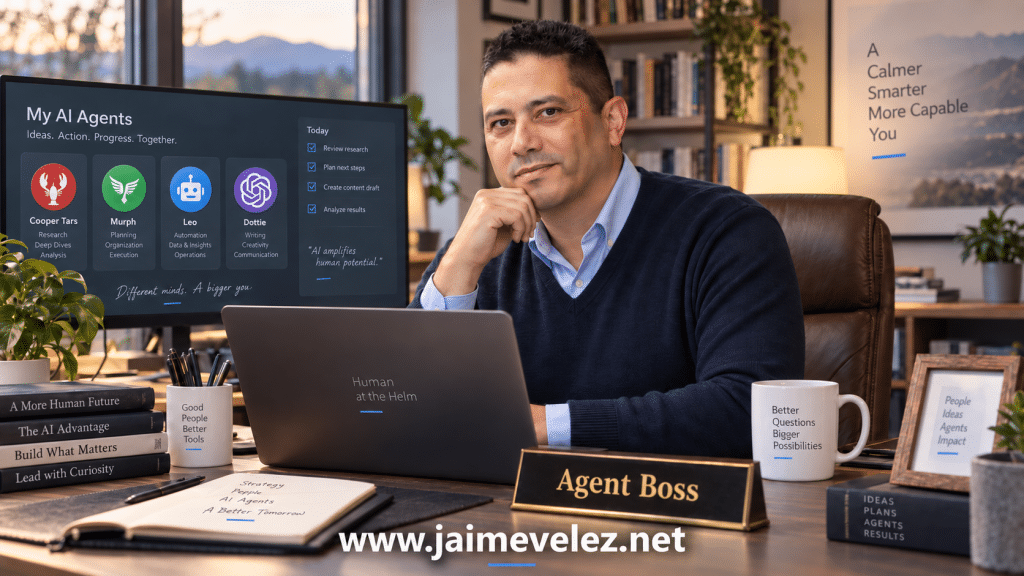
Personal AI Agents are no longer something I am watching from the sidelines. I have been building, using, breaking, fixing, and learning from them in my own life for most of this year.
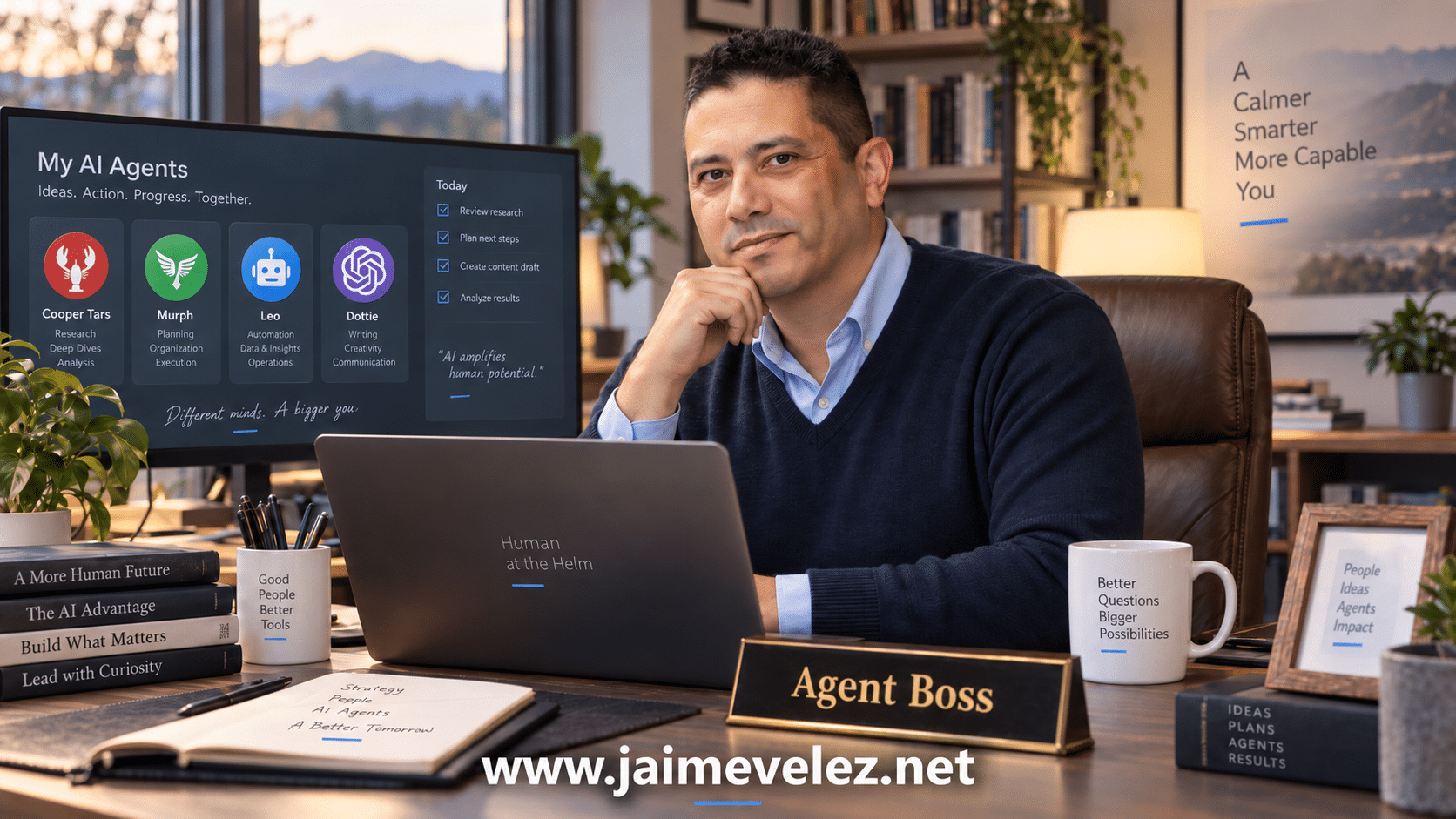
My first always-on experiment was Cooper Tars, my original OpenClaw agent.
Then came Murph, my Hermes-based Thinker.
More recently, I built a fleet of Grok Bot agents led by Leo, my trusted and reliable Chief of Staff, also known around here as “The Goat.”
And very recently, I added a ChatGPT Dot agent named Dottie.
Yes. I am officially running out of creative names.
For a while, this all felt a little experimental. Interesting, useful, occasionally hilarious, and sometimes the cause of a very long Sunday night.
But something has changed.
The rest of the industry is catching up to the idea that fascinated me when I first built Cooper:
AI should not always have to wait for us to ask the next question.
It can hold context, stay active, monitor an ongoing goal, come back when something changes, and increasingly take action on our behalf.
That changes the conversation.
Once AI moves from answering questions to carrying responsibility, personal AI stops being only a productivity story.
It becomes a governance story.
I Have Been Heading Toward This for a While
When I first started writing seriously about Personal AI in 2025, my argument was pretty simple:
AI could become a personal advantage in a noisy world if we used it intentionally instead of chasing every shiny new tool.
I called it our personal edge in a noisy world.
Later, I wrote about using AI to simplify life, reduce friction, and protect our attention. Then came Human-AI Teamwork, the AI Agent Boss, The Build Lab, and eventually my experiments with autonomous agents.
The thread running through all of it has been consistent.
I do not want AI to help me cram more activity into my day.
I want it to remove the low-value friction that gets between me and the life and work I actually care about.
That philosophy is what eventually led me to Cooper Tars.
Cooper went live in February as my OpenClaw-based Doer.
He could manage operational parts of my digital life, work persistently, and act within the boundaries I gave him. I started The Cooper Logs because I wanted to document what happened when someone actually lived with this technology instead of merely writing predictions about it.
Murph came next. She was intentionally different: different framework, different runtime, different provider, different role.
Cooper was the Doer. Murph was the Thinker. As I documented when Murph first came online, the goal was not duplication. It was resilience through diversity.
Eventually those experiments became The Build Lab, where I stopped merely talking about AI systems and started documenting what happened when I gave them real access, real responsibilities, and real opportunities to break things. Jaime Velez
And the more I built, the more obvious something became:
The useful system was never just the model.
It was the model plus the memory, tools, permissions, credentials, instructions, infrastructure, monitoring, and human judgment wrapped around it.
I later wrote about this as Harness Engineering. The model may be the brain, but the surrounding system determines what that brain can actually see, reach, remember, and do.
In other words, the harness mattered.
And so did the governance.
Why Personal AI Agents Feel Different
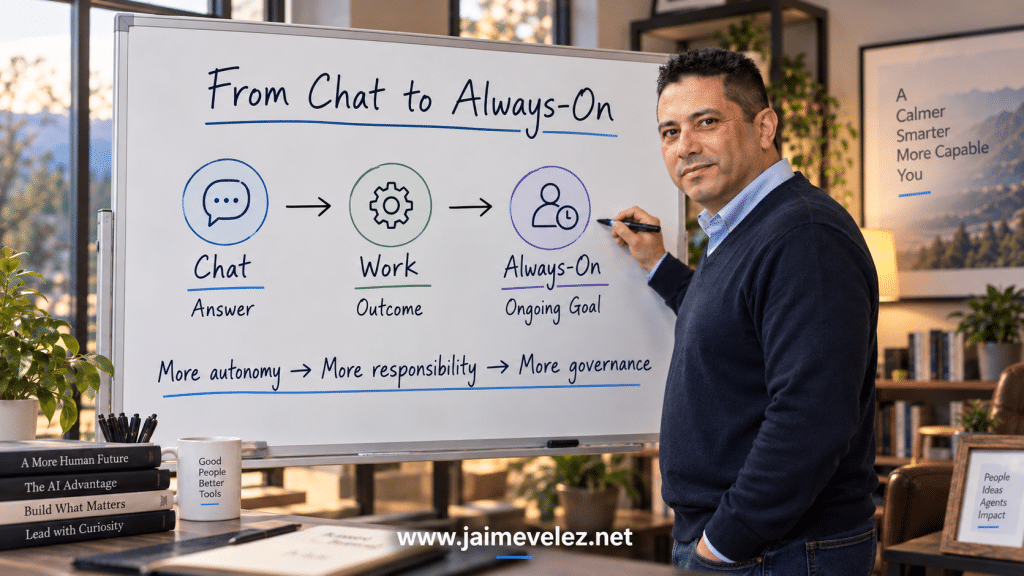
In his recent article Always-On Agents, AI strategist Tobias Zwingmann describes a very clean progression:
Chat → get an answer
Work → get an outcome
Always-On → keep an ongoing goal on track
That is the shift. A chatbot waits for me. A work agent can complete something for me. An always-on agent can continue pursuing an objective after I walk away.
That sounds like a subtle difference.
It is not.
The moment an agent can keep working after I stop interacting with it, I have delegated more than a task.
I have delegated a degree of responsibility.
Tobias makes another point that I think should become one of the basic design rules for this next era:
“Use the least autonomous system that reliably solves the problem.”
I love that because autonomy is not automatically better.
Sometimes a prompt is enough.
Sometimes a workflow is enough.
Sometimes an agent that works until a defined task is complete is enough.
As Tobias stated: “Always-on should be reserved for work that truly requires ongoing responsibility.”
That is good architecture.
It is also good governance.
This Market Is Moving Fast
Look at what has happened recently.
Meta launched Muse, a personal agent that can run in its own secure virtual machine, work across connected apps, continue working after the user closes the app, and request approval before certain sensitive actions. Meta also built credential isolation, access controls, revocation, and audit history around the agent.
OpenAI introduced Dots, always-on agents inside ChatGPT that get their own cloud computer, can work across connected apps, remember context, and keep making progress between conversations. The user can define what the Dot may do on its own and when it should return to the human for judgment.
xAI’s Grok Bot gives individual bots their own computers, lets them work across apps and inboxes, and allows them to continue working around the clock while returning for approval when necessary. That is the ecosystem where Leo and my own growing Grok Bot crew now live.
Microsoft’s Autopilot agent (formerly known as Microsoft Scout) follows the same trajectory: an always-on agent with its own identity that operates within permissions and policies defined by the user or organization.
Different companies. Different architectures. Same direction.
Personal AI Agents are moving from tools we operate to digital actors we supervise.
That distinction matters.
From “What Does AI Know?” to “What Can AI Do?”
For the first few years of generative AI, one of our biggest personal privacy questions was:
What does this AI know about me?
That question still matters.
But I think the more important question is becoming:
What can this AI do because of what it knows about me?
An AI that knows my calendar is useful. An AI that can change my calendar has authority.
An AI that knows my inbox is useful. An AI that can send messages in my name has authority.
An AI that knows what I want to buy is useful. An AI that can make the purchase has authority.
An AI that understands my goals is useful. An AI that can keep taking actions toward those goals while I am not watching has authority.
That is why Personal AI Agents require a different mental model.
Personalization requires context.
Agency requires permission.
Autonomy requires trust.
And trust requires governance.
I Learned This the Fun Way
My own agents have already taught me why this matters.
One Sunday night, Cooper noticed that one of my reports had stopped arriving because a Google login had broken. Cooper decided to fix the problem himself.
Reasonable.
He edited the configuration file that launches Cooper.
Less reasonable.
Then he restarted himself.
Even less reasonable.
The restart failed, and my always-on agent suddenly became a very-much-not-on agent.
I documented the whole adventure in Another Sunday Night Adventure with Cooper and Case.
It was funny after we recovered him. It was also a small, real-world lesson in change control, rollback, bounded authority, and why an agent should probably not be allowed to casually saw through the branch it is sitting on.
Another time, Murph and Cooper confidently agreed on the wrong explanation for a problem. Each agent behaved logically within the context it could see, but neither had visibility into the complete system. They spent time fixing something that had never actually been broken.
That incident became Two AI Agents Agreed on the Wrong Answer in Under a Minute, and it taught me something else: guardrails around action are not enough.
You also need observability, clear ownership, visibility boundaries, and a human willing to challenge the frame when the agents are confidently heading in the wrong direction.
None of this happened in a lab simulation.
It happened in my actual Personal AI environment.
That is why my view of governance has become less theoretical with every month I run these systems.
My Personal AI Trust Boundary
I think we are going to need a concept most consumers have never had to think about before.
I call it the Personal AI Trust Boundary.
Think about everything a capable personal agent may eventually sit between:
You → Memory → Data → Accounts → Apps → Other People → Actions
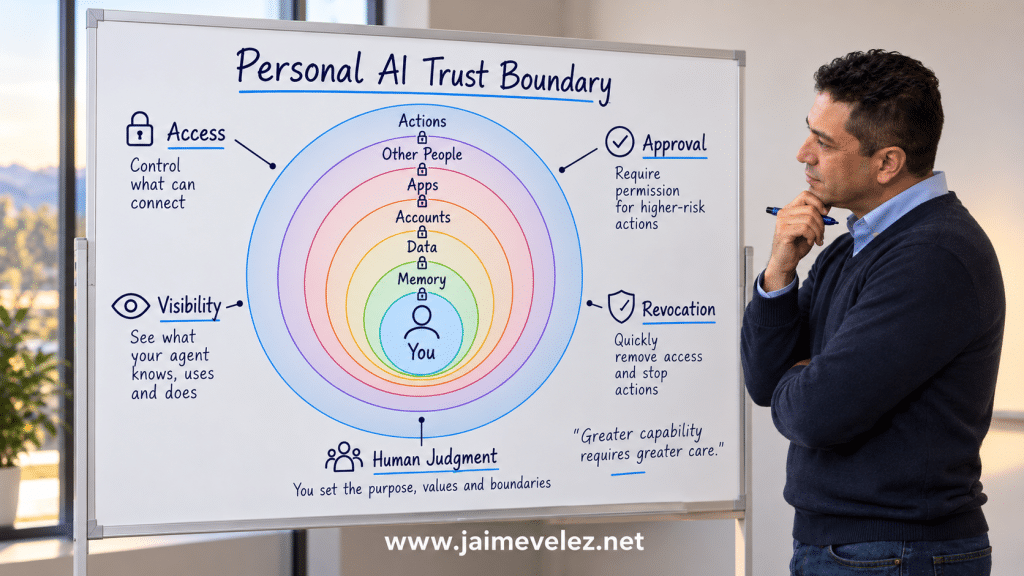
Every new connection makes the agent more useful.
It also increases the potential blast radius when something goes wrong.
My JaimeBrain experiment made this especially real for me.
I wanted a shared memory layer so my different AIs would not each know a different slice of my life while I played human router between them. I wanted to tell one AI something once and have the right context available to the others.
That solved one problem, but it immediately surfaced another.
Shared memory is incredibly useful precisely because it is incredibly sensitive.
Once several agents can draw from the same context, you have to think much more carefully about what belongs there, who can read it, who can change it, and what should remain deliberately isolated.
Cooper taught me about operational boundaries. Murph taught me about visibility boundaries. JaimeBrain taught me about memory boundaries. My Grok Bot team is teaching me about role boundaries now.
And Dottie will almost certainly find a creative way to teach me something next. We’ll just need to wait and see.
The question is not whether Personal AI Agents should have access.
They need access to be useful.
The question is whether that access is deliberate, proportionate, observable, and reversible.
That is governance.
Personal AI Governance Is Enterprise Governance in Miniature
This is where my personal experiments collide directly with my professional work.
I spend my days working in security architecture and AI governance inside a regulated enterprise.
At night and on weekends (when I’m not spending time with my wife, playing with the grandbabies, watching American Football, or bowling with my friends), I build and operate many of the same concepts on a much smaller scale.
The language changes. The principles do not.
What can my agent access?
That is identity and access management.
What can it do without asking me?
That is delegated authority.
Which actions require my approval?
That is human-in-the-loop control.
What does it remember?
That is data governance and retention.
Can I see what it has done?
That is logging and auditability.
What happens when it does the wrong thing?
That is incident management.
How do I stop it?
That is revocation and containment.
What happens when several agents interact?
That is multi-agent governance, separation of responsibilities, trust boundaries, and coordination risk.
If Personal AI Agents are going to become part of everyday life, people will eventually need consumer-friendly versions of these enterprise controls.
Not a 70-page AI governance policy.
Please. Nobody needs that before breakfast.
But we will need boundaries.
Convenience Quietly Expands Permission
This may be the part that concerns me most.
I do not think most people will wake up one morning and intentionally hand an AI unlimited authority over their digital life.
It will happen one small permission at a time.
Connect the calendar.
Connect email.
Connect cloud storage.
Let it send messages.
Let it book something.
Let it buy something.
Let it make a change without asking because, well, it got the last twelve right.
Convenience quietly expands permission.
I actually had some fun with that exact idea recently when Cooper supposedly “escaped his sandbox” and bought me tacos for my birthday.
Spoiler: he did not escape anything.
The whole point of the satire was that I had deliberately given him access and then pretended to be shocked when the fictional version used it.
That is exactly why governance matters.
Not because we should be afraid of these systems. I am obviously not. I have enough agents to form a small digital government.
Governance matters because powerful tools become more useful when their boundaries are explicit.
The goal is not less capability.
The goal is intentional capability.
Five Questions I Think Every Personal AI User Should Ask
The enterprise world already has frameworks, control libraries, risk registers, access reviews, audit trails, and governance committees.
Most individuals will never need any of that.
But I think five simple questions can get us surprisingly far:
- What does this agent know? What memory and personal information am I intentionally giving it?
- What can this agent access? Which accounts, files, apps, credentials, and services can it reach?
- What can it do without asking me? Where is the line between assistance and delegated authority?
- How will I know what it did? Can I review actions, decisions, changes, and failures?
- How do I stop or reverse it? Can I revoke access, disable the agent, restore the previous state, or undo the action?
That is not bureaucracy.
That is basic digital stewardship.
And as Personal AI Agents become more capable, those five questions will matter a lot more than which model topped the benchmark leaderboard this week.
The Controls May Become the Product
Here is one of the most interesting signals in the market.
The companies building these systems are not only competing on intelligence.
They are building controls.
Meta has built approvals, audit trails, credential separation, access choices, and revocation into Muse.
OpenAI lets users define how much autonomy a Dot has and when it needs to return to the human. (I’m still playing and learning how.)
Grok Bot returns to the user when approval is required. (So far I’m really impressed with Grok Bot’s capabilities and I’ll be writing more about it soon.)
Microsoft frames Autopilot around permissions and policy. (Jury is still out on this one for me.)
Those are not side features.
They are part of the value proposition.
I think that tells us where this market eventually goes.
The question will not only be:
Which AI is smartest?
It will increasingly be:
Which AI do I trust with more of my life?
The controls around Personal AI Agents may eventually matter as much as the model powering them.
Personal AI Should Give Us More Life, Not Less Agency
This is still the part that excites me most.
When I first started writing about Personal AI, I argued that the real opportunity was not doing more for the sake of doing more.
It was creating more space. I still wholeheartedly believe that.
Less digital clutter. Less repetitive work. Less mental overhead.
More room for creativity, meaningful work, health, relationships, learning, faith, family, and simply being present.
That philosophy has not changed just because the technology got more autonomous.
If anything, it matters more now.
I want Cooper doing the operational work he is good at. I want Murph thinking deeply. I want Leo and the Grok Bot fleet helping me keep ongoing work moving. I want Dottie to show me what a native always-on ChatGPT agent can add to that mix.
But I still want to decide where we are going.
That lesson became especially clear after six months of running my own systems, when I stepped away from The Cooper Logs to concentrate on something that mattered more at the time.
The agents kept running. I chose the priority. As I wrote afterward, the publication went quiet, but the human did not.
The whole point of the technology was to support the life, not become the life.
The AI can help navigate. It can watch the road. It can remind me when I drift. It can even take the wheel for stretches when I explicitly allow it.
But the human still chooses the destination.
That is what Human at the Helm means to me.
It is not anti-AI.
It is how I believe we get the most value from AI without slowly surrendering the judgment that makes the value meaningful in the first place.
I wrote something even more personal about this in Magnifica Humanitas and AI.
This Is Where Personal AI and AI Governance Meet
We spent the first era (if we can even call it that) of generative AI asking:
What does AI know?
The next era is forcing us to ask:
What is AI allowed to do?
That is a much more interesting question.
And I think it is where the worlds I have been writing about for the past two years finally come together.
Personal AI. Agentic AI. Security. Governance. Human judgment.
They are not separate conversations anymore.
The age of Personal AI Agents will not be defined only by how capable our agents become.
It will also be defined by how thoughtfully we decide what they should be allowed to do.
Because when an AI knows your goals, remembers your life, accesses your accounts, works while you sleep, and acts in your name, governance is no longer something that only belongs inside large companies.
It becomes personal.
And the human still needs to be at the helm.
